Local SEO has become the cornerstone of digital visibility for businesses serving geographic markets, transforming how customers discover and choose local services through proximity-based search queries on Google Maps, voice assistants, and location-aware search results. With 46% of all Google searches carrying local intent and 80% of US consumers searching for local businesses weekly, this comprehensive guide explains Local SEO as the strategic optimization of online business presence to attract nearby customers actively searching for products or services within specific cities, neighborhoods, or regions searches that drive immediate action, with 88% of mobile local searchers visiting or contacting businesses within 24 hours and 78% of mobile local searches resulting in offline purchases, often the same day.
Understanding Local SEO requires mastering three core ranking pillars: proximity measures physical distance between business and searcher, relevance evaluates how well offerings match search intent, and prominence reflects overall authority through reviews, citations, and online reputation which search engines combine to determine which businesses appear in the coveted Local Pack that captures 42% of clicks during local searches and dominates local search visibility. The guide provides systematic instruction across every critical Local SEO component: claiming and optimizing Google Business Profile as the central hub of local presence where consumers are 2.7 times more likely to trust businesses with complete profiles and 86% of profile views originate from category-based searches like “dentist open now” rather than branded queries, building citation consistency across directories to establish trust signals, implementing strategic review generation systems that leverage customer feedback as powerful ranking factors since 83% of consumers use Google to find local business reviews, creating location-specific website content enhanced with LocalBusiness schema markup, earning quality backlinks from local news outlets and community organizations, and maintaining mobile-optimized experiences that serve the reality where 71% of Google Business Profile interactions originate from mobile devices.
Practical implementation follows through detailed checklists covering NAP consistency, on-page optimization, reputation management, and technical requirements, while addressing common mistakes like inconsistent business information, neglected profiles, and duplicate content that undermine rankings, critical issues since only 13% of consumers would consider engaging with a business rated 1 or 2 stars. The content extends beyond current best practices to explore emerging trends reshaping local discovery AI-powered search generating direct answers where 32% of US adults believe AI provides better local business search experiences, hyper-local neighborhood targeting, voice search adoption where 58% of consumers have used voice search to find local business information, and the evolution of Google Business Profile into a complete digital storefront ensuring businesses build sustainable strategies that adapt to algorithm changes while capturing high-intent local customers ready to purchase.
What is Local SEO?
Local SEO, or Local Search Engine Optimization, is the process of optimizing a business’s online presence to attract customers from specific geographic areas through location-based search queries. It focuses on improving visibility in local search results, especially on Google’s Local Pack, Google Maps, and location-specific organic searches where users look for products or services “near me” or within a particular city or neighborhood.
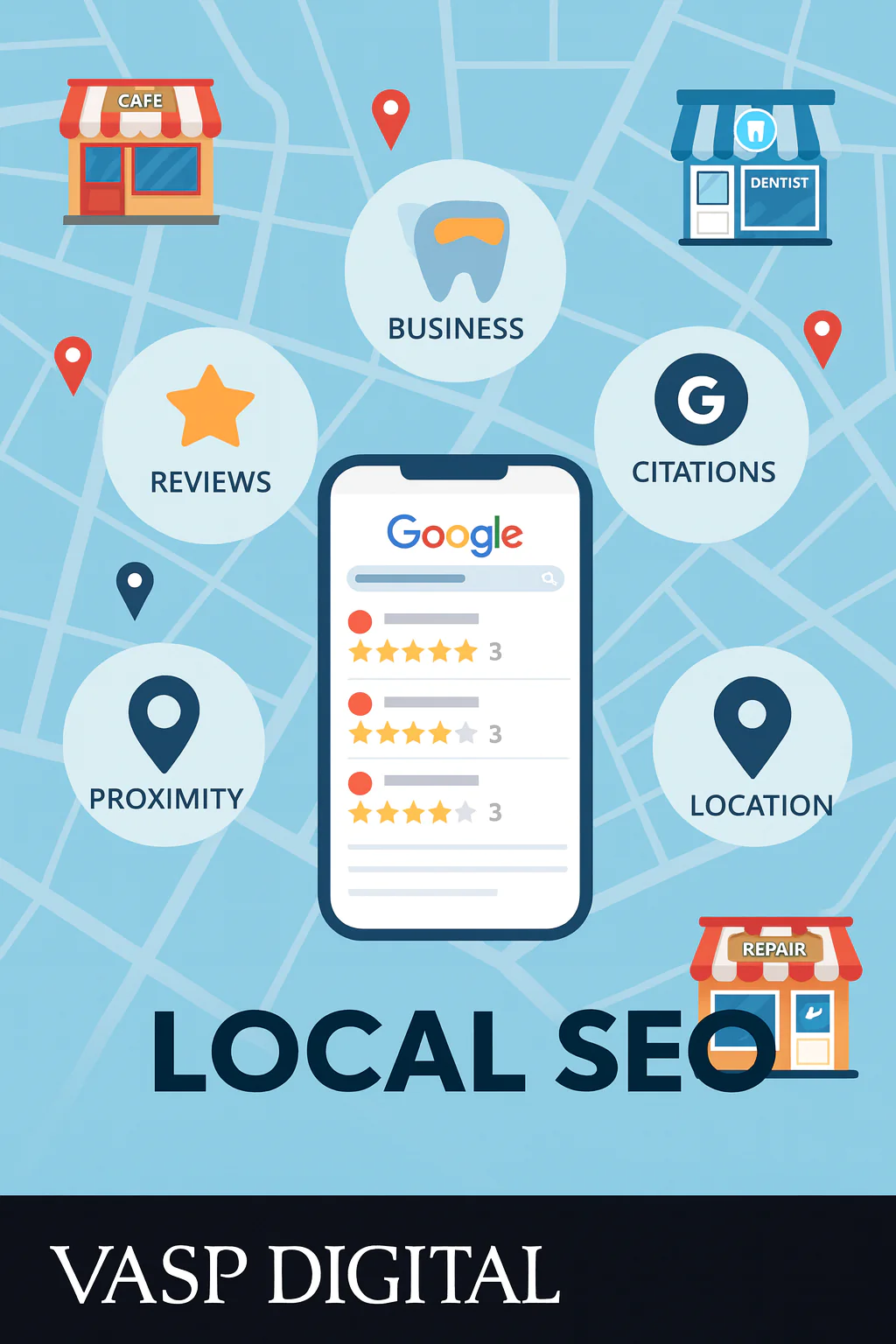
Local SEO operates on three key ranking factors: proximity, relevance, and prominence.
- Proximity measures how close a business is to the searcher’s location or the area mentioned in the query.
- Relevance reflects how well a business’s offerings match the searcher’s intent, category, and needs.
- Prominence indicates the business’s overall authority and reputation, shaped by reviews, citations, backlinks, and online visibility.
Unlike traditional SEO, which targets broad national or global audiences, Local SEO focuses on geographically qualified searches with strong purchase intent. People searching for “coffee shop downtown” or “plumber near me” are typically ready to visit a store or hire a local service. This makes Local SEO especially valuable for physical storefronts, service-based businesses, and companies serving specific local markets.
The foundation of Local SEO lies in accurate and consistent business information across the web. Maintaining uniform NAP data (Name, Address, Phone number) ensures search engines can trust and verify the business. A verified Google Business Profile is the central element of local visibility, connecting businesses directly with local searchers. Complementary factors such as directory citations, authentic customer reviews, localized website content, and structured data markup all reinforce a business’s trust and relevance in local search results.
Local SEO attracts high-intent customers who are actively searching for nearby solutions, leading to higher conversion rates and increased in-store visits. For local businesses, it offers a cost-effective way to compete with larger brands, build community trust, and capture market share within their geographic area.
Examples of Local SEO
Local SEO appears in many forms across search engines and online platforms, all designed to connect nearby customers with local businesses.
1. Google Local Pack (Map Pack)
The most visible form of Local SEO is the Local Pack, also known as the Map Pack. It appears at the top of search results for location-based queries such as “dentist in Brooklyn” or “Italian restaurant near me.” Google highlights three local businesses in a featured box showing their ratings, addresses, phone numbers, and map locations. Ranking within this three-pack is one of the main goals of any Local SEO strategy because it attracts high visibility and immediate user attention.
2. Google Maps Results
Google Maps is another critical area where Local SEO comes into play. When users search within Google Maps or click a listing from the Local Pack, they see a list of nearby businesses ranked by relevance, distance, and prominence. Businesses optimized for Local SEO appear higher in these results and often feature enhanced listings that include photos, operating hours, customer reviews, and direct call or booking options.
3. Location-Specific Organic Results
Local SEO also influences standard organic search results. Search engines now personalize rankings based on a user’s physical location, even when no city name or “near me” phrase is used. For example, a search for “emergency electrician” prioritizes local service providers over national directories or distant competitors. This personalization ensures users see the most relevant nearby options first.
4. Voice Search Optimization
Voice search relies heavily on Local SEO data. When users ask their phone or smart speaker questions like “Where’s the nearest pharmacy?” or “What hardware stores are open now?” the device typically delivers a single local recommendation. These results are pulled from well-optimized business profiles that include accurate hours, verified locations, and strong prominence signals such as positive reviews and engagement.
5. Local Business Directories
Platforms such as Yelp, Yellow Pages, Apple Maps, Bing Places, and industry-specific directories also represent active Local SEO channels. Businesses that maintain consistent NAP information (Name, Address, Phone number), complete profiles, and genuine customer reviews across these directories strengthen their local presence. Each accurate citation reinforces a business’s credibility and helps search engines confirm its legitimacy.
In every form, maps, voice search, organic results, or directories, Local SEO serves the same goal: improving visibility for nearby customers and turning online searches into real-world visits or calls.
What is the Difference Between Local SEO and Regular SEO?
Local SEO and regular SEO both aim to improve online visibility but differ in focus and strategy. Local SEO targets searches with geographic intent, optimizing for proximity, Google Business Profile, reviews, and citations to attract nearby customers. Regular SEO targets broader audiences through content, backlinks, and technical optimization to build national or global visibility.
Why is Local SEO Important?
Local SEO has become essential for any business serving a geographic market. Changing consumer behavior and the dominance of mobile devices have made local visibility critical to customer acquisition and sustained growth.
1. Massive Local Search Volume Drives Consumer Decisions
- Google processes around 97 billion local searches every month, which equals nearly 37,000 local searches every second. Nearly half of all Google searches carry local intent, meaning users are looking for something nearby.
- In the United States, 80% of consumers search online for local businesses weekly, and 32% do so daily.
- Almost everyone has searched online for a local business in the past year, with the majority of users conducting searches specifically to find businesses in their immediate area.
- Local search has replaced traditional directories and word-of-mouth as the primary way consumers discover, evaluate, and choose businesses in their communities.
2. Immediate Action and High Purchase Intent
Local SEO connects businesses with ready-to-buy customers.
- 88% of consumers who perform a local search on their smartphone visit or contact a business within 24 hours.
- 78% of mobile local searches result in offline purchases, often the same day.
- 72% of people searching for local information visit a store within five miles, and 28% of those searches lead directly to a purchase.
These statistics show that local searchers are action-oriented and typically make fast purchasing decisions following their search.
3. “Near Me” Searches Reflect Urgent Consumer Needs
- Mobile searches including phrases like “can I buy near me” or “to buy near me” have increased by more than 500% in recent years.
- Searches including “near me now” have risen by 150%, and “near me today” or “tonight” queries have grown by 900%.
- Searches combining “open,” “now,” and “near me” are up more than 200%, reflecting consumers’ demand for real-time availability and immediate service when they’re ready to buy.
- Overall, “near me” searches have grown by over 900%, showing how strongly consumers rely on location-based search to find nearby solutions.
4. Mobile Dominance in Local Discovery
Local SEO is now mobile-first.
- Nearly one-third of all mobile searches are location-based, and 76% of people who search locally on their phones visit a business within a day.
- Over 80% of local searches happen on smartphones, and most users expect instant access to directions, hours, and contact information.
- Mobile local searches are growing 50% faster than overall mobile searches.
- Since over 60% of web traffic now comes from mobile devices, having a mobile-optimized, responsive website is essential for visibility and usability in local results.
How Does Local SEO Work?
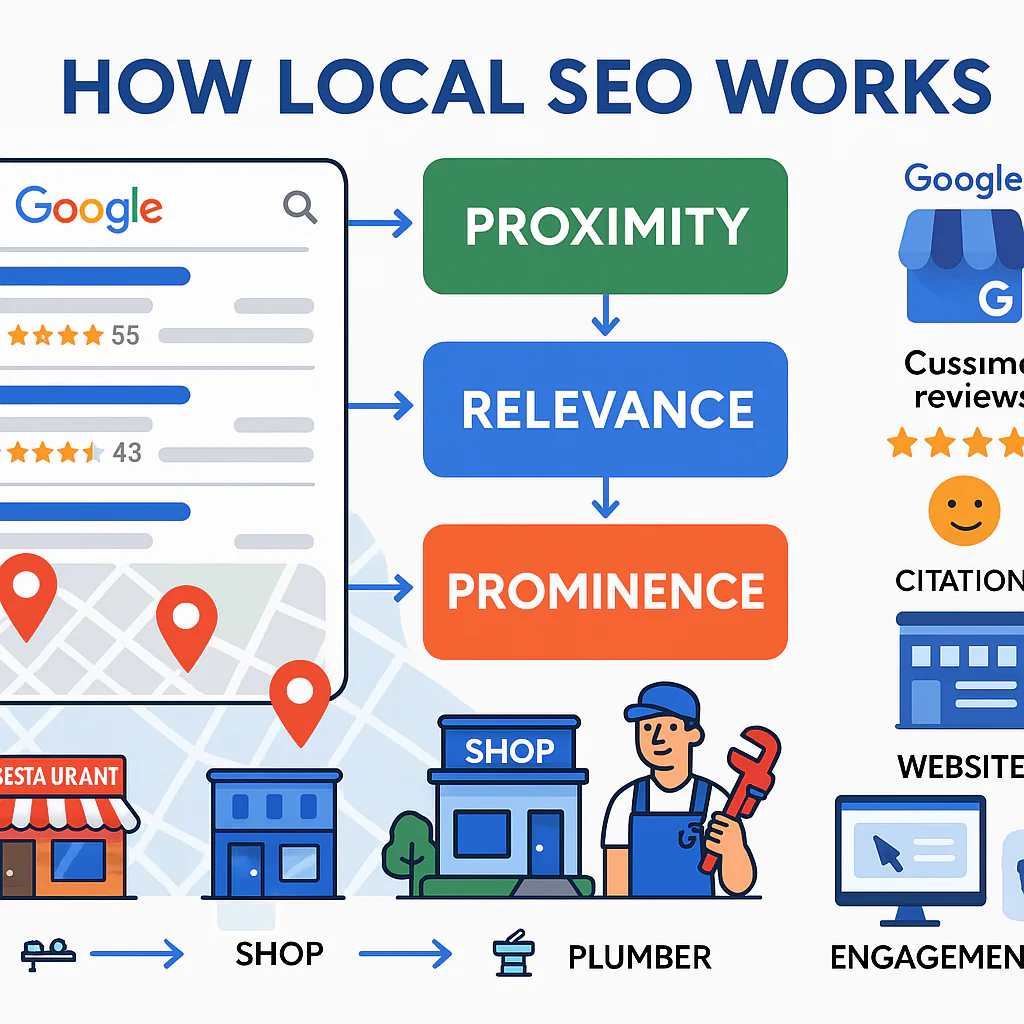
Local SEO works by combining geographic data, business information, and authority signals that search engines use to decide which businesses appear in local results and how they rank. It focuses on proving a business’s relevance, proximity, and trustworthiness to nearby searchers.
1. The Three Core Ranking Pillars
Local SEO rankings are built on proximity, relevance, and prominence.
- Proximity measures how close a business is to the searcher’s location or the area in the query. A user searching for “coffee shop” downtown will see different results than someone searching from the suburbs.
- Relevance assesses how well a business matches what the user wants, based on its category, listed services, keywords, and on-site content. A restaurant labeled “Italian Restaurant” with menu pages for pasta and pizza ranks well for “Italian food near me.”
- Prominence reflects authority and reputation. Search engines measure review quality, citation consistency, backlink strength, and overall online visibility to determine how well-known and trusted a business is.
2. Google Business Profile as the Central Hub
The Google Business Profile (GBP) is the foundation of Local SEO. A verified, complete, and actively managed profile gives Google reliable data about the business’s name, address, phone number, hours, service areas, and categories. Search engines prioritize verified profiles because they confirm legitimacy. Businesses that update their GBP regularly, add photos, and respond to reviews are more likely to earn top visibility in local search and Maps results.
3. Citation Network and NAP Consistency
Search engines verify business details by scanning citations mentioning a business’s name, address, and phone number across directories and websites. Consistent NAP data across reputable sources such as chambers of commerce, local directories, and government registries builds trust. Inconsistent listings (different phone numbers or outdated addresses) reduce credibility and can lower rankings. High-quality citations from official or industry-specific sources carry more weight than generic listings.
4. Review Signals and Reputation
Customer reviews are one of the strongest ranking signals in Local SEO. Search engines analyze not just ratings, but also review quantity, freshness, sentiment, and response behavior. A business with a steady stream of genuine, positive reviews appears more active and trustworthy. Google evaluates these patterns, review velocity, recency, and owner engagement to determine prominence and relevance.
5. On-Page and Technical SEO
The business website still plays a key role. Search engines evaluate:
- Location pages for each service area
- Structured data markup (schema.org LocalBusiness)
- Page speed and mobile usability
- Localized, high-quality content
Websites that clearly describe local services, include embedded maps, and use structured data make it easier for search engines to confirm relevance and display rich results in local listings.
6. Behavioral and Engagement Signals
Search engines monitor how users interact with local results. High click-through rates, calls, direction requests, and website visits indicate relevance and trust. Businesses that receive frequent interactions signal strong user satisfaction, leading to improved rankings over time.
7. Link Signals and Local Authority
Local backlinks strengthen prominence. Links from local newspapers, chambers of commerce, bloggers, or community organizations show that a business is active and recognized in its area. These local references carry more value than links from unrelated or national sites. While domain authority matters, local backlinks are especially powerful for community relevance.
8. Temporal and Contextual Factors
Local rankings shift based on time and context. Restaurants may rank higher during meal hours, or 24-hour businesses may appear more often in late-night searches. Seasonal operations, such as landscapers or tax services, gain visibility during peak months. Personalization also plays a role users who frequently engage with a business are more likely to see it ranked higher in future searches.
9. Service Area vs. Physical Location Logic
Search engines handle service-area businesses (like plumbers or cleaning companies) differently from storefronts. These businesses can hide their address but must define service areas clearly. Google verifies them through consistent citations, service-related content, and customer reviews mentioning service locations. Strong, transparent data helps prevent fake listings and confirms legitimacy.
10. The Local SEO Feedback Loop
Local SEO creates a self-reinforcing cycle. Optimized businesses appear prominently in search results, attracting more clicks, reviews, and engagement. These new signals strengthen trust and visibility, pushing the business even higher in rankings. Established local businesses often dominate because they’ve built strong prominence over time something newer competitors must earn through consistent optimization.
What is the Difference Between Google Maps and Local Search Results?
Google Maps and local search results both display local businesses but serve different user intents. Local search results appear within Google Search as quick, proximity-based listings in the Local Pack. Google Maps offers a detailed, interactive map view with richer business profiles, deeper results, and stronger emphasis on relevance and engagement.
What Are Local SEO Ranking Factors?
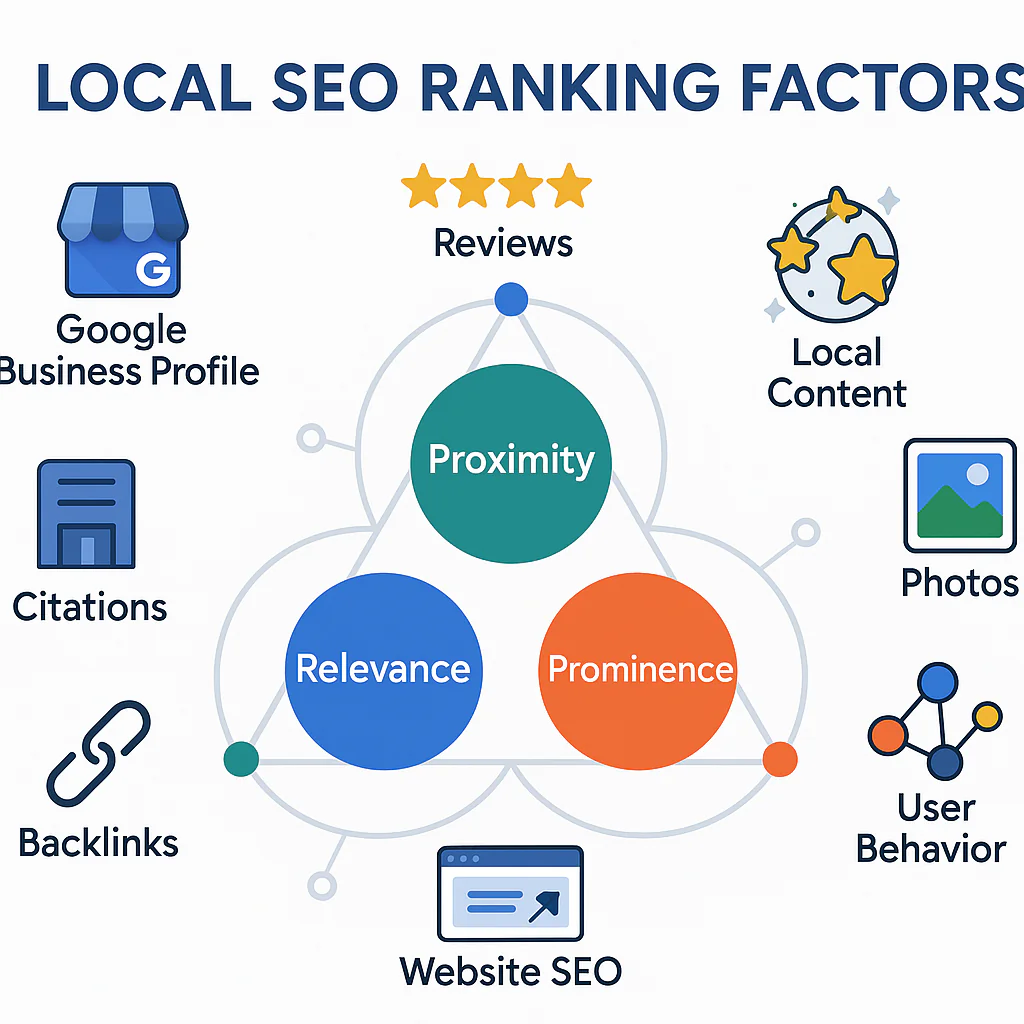
Local SEO ranking factors are the key signals search engines use to determine which businesses appear in local search results and how high they rank. These factors work together to measure proximity, relevance, and prominence, which form the foundation of local search visibility.
1. Proximity Factor
Proximity measures how close a business is to the searcher’s location. Search engines prioritize nearby businesses because users usually want fast, local solutions. When someone searches for “coffee shop,” Google identifies their position through GPS or IP data and ranks nearby businesses first. The closer the business is, the higher its chances of appearing in the Local Pack. Proximity has a stronger influence on urgent services such as plumbing or towing than on businesses where customers are willing to travel farther.
2. Relevance Factor
Relevance evaluates how well a business matches what the searcher is looking for. Search engines analyze information from the Google Business Profile and the website to determine if a business fits the search intent. The primary category defines the main service area, while additional categories expand visibility. Accurate descriptions, service lists, and attributes with related keywords improve relevance. Website content, especially local landing pages that reference neighborhoods or landmarks, helps confirm the business’s connection to the area.
3. Prominence Factor
Prominence reflects a business’s reputation, authority, and popularity online. Search engines measure prominence through customer reviews, backlinks, citations, and brand searches. Businesses with many positive reviews and mentions across reputable sites appear more trustworthy. Links from respected directories or local publications further strengthen prominence, helping the business appear more credible and well-established in its community.
4. Google Business Profile Optimization
A complete and verified Google Business Profile is critical for ranking well in local searches. Accurate information, such as the business name, address, phone number, hours, and website link builds trust. Adding descriptions, photos, and attributes improves visibility. Regular updates, customer replies, and posting new content signal that the business is active and well-maintained.
5. Review Signals
Customer reviews strongly influence both visibility and trust. The number of reviews, their star ratings, and how recent they are all affect rankings. Frequent, positive, and detailed reviews help build credibility. Search engines also evaluate review sentiment and owner responses. Active engagement and consistent review growth show customer satisfaction and business reliability.
6. Citation Consistency and Quality
Citations are mentions of a business’s name, address, and phone number across online directories. Consistent information across multiple trusted sources builds confidence in the business’s legitimacy. Errors, outdated details, or mismatched formats create confusion and lower rankings. Citations from recognized platforms such as the Better Business Bureau or local chamber directories carry more weight than low-quality listings.
7. On-Page SEO Signals
A well-optimized website supports local search performance. Each location should have a dedicated page with unique, locally relevant content. Title tags, meta descriptions, and headings should include city or neighborhood names. Adding structured data with the LocalBusiness schema helps search engines read important information such as hours, services, and reviews. A fast, mobile-friendly, and secure website improves user experience and strengthens local visibility.
8. Behavioral Signals
User behavior provides feedback that affects rankings. Search engines monitor how often people click, call, or request directions from a business listing. High engagement shows that the business matches user intent. Longer time spent on the site and lower bounce rates also send positive signals. Poor engagement can lead to lower visibility in local results.
9. Link Signals and Domain Authority
Backlinks from trusted websites increase a business’s authority. Local links from community organizations, local news outlets, and business associations are especially valuable. Quality matters more than quantity. A strong backlink profile combined with relevant content helps improve both organic and local rankings.
10. Business Category Selection
Choosing accurate business categories in the Google Business Profile is essential. The primary category determines which searches the business can appear for, while additional categories cover related services. The categories used should remain consistent across all citations to prevent confusion and maintain relevance.
11. Photos and Visual Content
High-quality photos increase customer engagement and trust. Listings with recent, authentic images perform better because they help users visualize the business. Photos of storefronts, interiors, products, and staff create familiarity. Regular updates show that the business is active and well-presented.
12. Q&A Engagement
Answering questions on the Google Business Profile builds credibility and improves customer experience. Quick and helpful responses demonstrate good service and reliability. Including relevant details or keywords in answers can also improve relevance for certain search queries.
13. Operating Hours and Availability
Accurate business hours are essential for visibility during searches. Google may prioritize businesses that are open when users search for services. Keeping hours updated, including holidays and special schedules, prevents missed opportunities and ensures customers can trust the information.
14. Localized Content Freshness
Publishing fresh, local content signals ongoing engagement and activity. Blog posts about community events, local partnerships, or special promotions help maintain visibility. Google Posts and regular updates also show that the business is active and connected to its area.
How To Optimize for Local SEO?
Optimizing for Local SEO requires a systematic approach that addresses all major ranking factors while building sustainable prominence and authority in your geographic market. The following strategies form the foundation of effective local search optimization.
Claim and Verify Your Google Business Profile:
Begin by claiming your business on Google Business Profile, the single most critical element of Local SEO. Navigate to business.google.com, search for your business, and claim the listing if it already exists or create a new one if it doesn’t. Complete the verification process typically through postcard mail, phone verification, email verification, or video verification depending on your business type and location. Verification status is non-negotiable; unverified profiles face severe ranking penalties or complete exclusion from local results. Once verified, your profile becomes the authoritative source for your business information across Google Search and Maps.
Complete Every Section of Your Google Business Profile:
Populate every available field in your GBP with accurate, detailed information. Enter your exact business name as it appears on your storefront and legal documents avoid keyword stuffing in the business name. Select your primary business category with precision; this drives relevance matching for your core searches. Add secondary categories only if you genuinely offer those services. Input your complete physical address exactly as it appears on official documents, ensuring consistency with all other online mentions. For service-area businesses without a physical storefront customers visit, hide your address and define service areas by city, postal code, or radius. Add your primary phone number preferably a local number that builds geographic trust. Include your website URL. Set detailed opening hours including special hours for holidays. Write a compelling business description using natural language that incorporates relevant keywords while clearly communicating what makes your business unique and why customers should choose you.
Optimize Business Categories and Attributes:
Choose categories strategically based on your primary services and target searches. Review Google’s category taxonomy to find the most specific, accurate category rather than settling for generic options. Add all applicable attributes these descriptive tags like “wheelchair accessible,” “outdoor seating,” “free Wi-Fi,” or “women-led” help your business appear in filtered searches and provide quick information to potential customers. Attributes improve both relevance matching and user experience by setting accurate expectations before customers visit or call.
Upload High-Quality Photos and Videos:
Visual content dramatically impacts user engagement and click-through rates. Upload a minimum of 10-15 high-quality photos initially, then add new photos monthly to signal active management. Include exterior shots clearly showing your building and signage for easy recognition, interior photos showcasing your space’s atmosphere and cleanliness, product or menu photos highlighting your offerings, team photos introducing staff to build a personal connection, and action shots showing your business in operation. Photos should be well-lit, high-resolution (at least 720px wide), and accurately represent your business. Add cover photos that make strong first impressions. For applicable businesses, create 360-degree virtual tours. Upload videos demonstrating your services, introducing your team, or showcasing your facility. Regularly refresh visual content to keep your profile dynamic and engaging.
Build and Maintain Citation Consistency:
Create listings on major citation platforms, ensuring your NAP information matches exactly across all sources. Start with primary data aggregators like Data Axle, Localeze, Factual, and Foursquare, which feed information to hundreds of downstream directories. Submit to major directories, including Yelp, Yellow Pages, Better Business Bureau, Bing Places, Apple Maps, Facebook, and industry-specific platforms relevant to your business type. Join your local chamber of commerce and ensure your business appears in their directory. List your business in city and regional business directories. The critical factor is absolute consistency in using identical formatting for your business name, complete address with consistent abbreviations, and the same phone number across every platform. Even minor variations like “Street” versus “St.” or including suite numbers inconsistently create citation conflicts that erode trust signals. Use citation management tools or services to monitor and maintain consistency across hundreds of sources. Regularly audit your citations to identify and correct inconsistencies, outdated information from previous locations, or duplicate listings that dilute authority.
Develop a Strategic Review Generation System:
Customer reviews serve as powerful ranking signals and conversion drivers. Implement systematic processes to encourage satisfied customers to leave reviews. Train staff to request reviews at the optimal moment after successful transactions, completed services, or positive interactions. Create simple review request workflows: send follow-up emails with direct review links, display QR codes linking to your Google review page at checkout counters or on receipts, include review requests in appointment confirmations or invoices. Make leaving reviews frictionless by providing direct links that minimize steps. Focus primarily on Google reviews as they directly impact GBP rankings, but also encourage reviews on industry-relevant platforms. Never incentivize reviews with discounts or payments this violates platform policies and risks penalties. Never filter review requests to only satisfied customers selective solicitation appears manipulative to algorithms. Respond professionally to all reviews, positive and negative. Thank customers for positive reviews, acknowledge specific details they mentioned, and invite them to return. Address negative reviews constructively, apologize for shortcomings, explain remediation steps, and invite offline resolution. Response rate and quality factor into prominence calculations and demonstrate customer service commitment to prospective customers reading reviews.
Create Location-Specific Website Content:
Build dedicated landing pages for each location you serve with substantial, unique content. For businesses with multiple physical locations, create individual pages with complete NAP information, unique descriptions of each location, specific staff information, location-specific photos, and directions with parking information. For service-area businesses, develop pages for each city or region served with genuinely useful local content not thin pages with only the city name changed. Discuss local landmarks, reference community characteristics, address area-specific needs or concerns, and demonstrate authentic local knowledge. Incorporate location keywords naturally in headings, body text, title tags, and meta descriptions without over-optimization. Create locally-relevant blog content discussing community events, local industry trends, neighborhood guides, or area-specific tips that position you as a community participant rather than just a business extracting value from the area.
Implement Structured Data Markup:
Add LocalBusiness schema markup to your website, providing search engines with machine-readable information about your business. Include structured data for your business name, address, phone number, business type, geographic coordinates, opening hours, price range, accepted payment methods, and aggregate rating information. Use the most specific schema type applicable: Restaurant, Dentist, or AutoRepair rather than generic LocalBusiness when appropriate. Include GeoCoordinates with precise latitude and longitude. Mark up opening hours, including special hours and seasonal variations. If you have multiple locations, implement a separate schema for each location on respective pages. Validate your structured data using Google’s Rich Results Test to ensure proper implementation. Structured data doesn’t guarantee rich snippets or enhanced display, but provides search engines with clear signals that support ranking and display decisions.
Optimize for Mobile Users:
Given that the majority of local searches occur on mobile devices, mobile optimization is non-negotiable. Ensure your website uses a responsive design that adapts seamlessly to all screen sizes. Test mobile usability using Google’s Mobile-Friendly Test tool and address any identified issues. Optimize page load speed for mobile connections, compress images, minimize code, leverage browser caching, and use content delivery networks. Make phone numbers click-to-call with proper tel: links. Ensure buttons and links are adequately sized for touch interaction. Simplify navigation for mobile users seeking quick information like hours, location, or contact details. Place critical information, phone number, address, and hours prominently above the fold on mobile views. Consider implementing accelerated mobile pages (AMP) for blogs or information pages to maximize mobile loading speed.
Earn Quality Local Backlinks:
Build a backlink profile emphasizing local and industry-relevant sources. Sponsor local events or youth sports teams that link to sponsors on their websites. Contribute expert commentary to local news publications, earning mentions and links. Join local business associations, chambers of commerce, and industry groups that provide member directories with links. Partner with complementary local businesses for cross-promotion and linking. Create genuinely valuable local resources, neighborhood guides, local industry reports, and community calendars that attract organic links from local bloggers and news sites. Guest post on local blogs or contribute to community publications. Pursue links from local universities, libraries, or government organizations when appropriate relationships exist. Participate in local charity work, earning recognition and links from nonprofit websites. Focus on link quality and relevance rather than quantity. One link from your city’s chamber of commerce provides more local authority than dozens of generic directory links.
Leverage Google Posts and Updates:
Regularly publish Google Posts directly on your GBP to demonstrate active management and provide fresh content. Share updates about new products or services, announce special offers or promotions, highlight upcoming events, share blog posts or resources, and showcase customer success stories. Posts appear directly in your knowledge panel and receive prominent placement when your business appears in results. While posts expire after seven days for most types, they signal business vitality and provide additional opportunities to include keywords and calls-to-action. Use compelling images with each post, write clear, benefit-focused copy, and include strong calls-to-action with appropriate buttons linking to specific pages.
Manage and Monitor Your Online Reputation:
Proactively monitor your business mentions, reviews, and reputation across all platforms. Set up Google Alerts for your business name to catch mentions and unlinked citations. Use reputation management tools to aggregate reviews from multiple platforms into a single dashboard. Address negative reviews promptly and professionally. Never argue, justify, or dismiss complaints publicly. Investigate legitimate complaints, implement improvements, and demonstrate willingness to make things right. Flag fraudulent or policy-violating reviews through proper channels when appropriate, but focus more energy on generating new positive reviews that dilute the impact of occasional negative feedback. Monitor competitors’ reputation strategies and review performance to identify opportunities and benchmark your own efforts.
Local SEO Checklist
Use this comprehensive checklist to ensure you’ve addressed all critical elements of Local SEO optimization. Check off each item as you complete it, and revisit quarterly to maintain optimization.
Google Business Profile Optimization
- Claim and verify your Google Business Profile
- Complete business name (accurate, no keyword stuffing)
- Select primary business category (most specific option)
- Add 2-4 secondary categories (only if genuinely applicable)
- Enter a complete physical address or define service areas
- Add primary local phone number
- Include website URL
- Set detailed opening hours, including special hours
- Write a compelling 750-character business description
- Add all applicable business attributes
- Upload a minimum of 15 high-quality photos (exterior, interior, products, team)
- Add cover photo
- Create 360-degree virtual tour (if applicable)
- Upload introductory video
- Add products or services with descriptions and pricing
- Upload menu (for restaurants)
- Set appointment booking link (if applicable)
- Verify that all information displays correctly in search results
Citation Building and NAP Consistency
- Audit existing citations for accuracy and consistency
- Create a standardized NAP format for use across all platforms
- Submit to major data aggregators (Data Axle, Localeze, Factual)
- Claim and optimize Bing Places listing
- Claim and optimize Apple Maps listing
- Create or claim a Yelp listing
- Create or claim a Facebook Business Page
- List on Better Business Bureau (if applicable)
- Submit to Yellow Pages
- Join and list on the local chamber of commerce website
- Submit to 20+ industry-specific directories
- Create listings on 10+ local city/regional directories
- Ensure NAP consistency across all citations
- Correct or remove duplicate listings
- Update outdated information from previous locations
- Document all citation sources for future reference
Review Management
- Implement a systematic review request process
- Create review request email templates
- Generate a direct Google review link or use your Google Business Profile’s built-in QR code to make it easy for customers to leave reviews.
- Train staff on when and how to request reviews
- Set up review monitoring alerts
- Respond to 100% of Google reviews (positive and negative)
- Develop response templates for common review types
- Create a process for addressing negative reviews offline
- Monitor reviews on secondary platforms (Yelp, Facebook, industry sites)
- Track review velocity and average rating trends
- Set monthly review generation goals
Website Optimization
- Create dedicated location page(s) with unique content
- Include complete NAP information on every location page
- Add an embedded Google Map on location pages
- Implement LocalBusiness schema markup
- Add GeoCoordinates to structured data
- Include OpeningHours in structured data
- Optimize title tags with location modifiers
- Optimize meta descriptions with location and value proposition
- Create locally-relevant blog content (minimum 4 posts)
- Optimize images with local alt text
- Ensure mobile responsiveness passes Google’s test
- Achieve a page load speed under 3 seconds
- Implement HTTPS across the entire site
- Make phone numbers click-to-call on mobile
- Add prominent contact information in the header/footer
- Create location-specific service pages
- Build an internal linking structure connecting location and service pages
- Validate structured data using Google’s Rich Results Test
Link Building and Authority
- Audit the existing backlink profile
- Earn a link from the local chamber of commerce
- Secure 5+ links from local business associations
- Earn 3+ links from local news publications or blogs
- Create linkable local resource content (guide, tool, report)
- Partner with 3+ complementary local businesses for linking
- Sponsor a local event, earning a website link
- Contribute guest post to a local publication
- Earn links from local government or educational institutions
- Pursue industry-specific authoritative links
- Monitor new backlinks monthly
- Disavow toxic or spammy backlinks if necessary
Content and Engagement
- Publish Google Post weekly
- Create offer posts monthly
- Announce events through GBP
- Share company updates regularly
- Post high-quality images monthly to GBP
- Respond to Q&A questions within 24 hours
- Seed Q&A section with 5+ common questions and answers
- Create location-specific blog content monthly
- Write about local events or community involvement
- Develop neighborhood guides or local resources
- Share content on social media with location tags
- Engage with the local community online
Technical and Mobile
- Pass Google Mobile-Friendly Test
- Achieve “Good” Core Web Vitals scores
- Implement responsive design
- Optimize images for mobile loading
- Enable browser caching
- Minify CSS and JavaScript
- Use a content delivery network (CDN)
- Ensure crawlability (check robots.txt)
- Submit XML sitemap to Google Search Console
- Fix crawl errors in Search Console
- Implement proper canonical tags
- Use proper heading hierarchy (H1, H2, H3)
Monitoring and Analytics
- Set up Google Search Console
- Track GBP insights (views, clicks, calls, direction requests)
- Monitor Local Pack rankings for target keywords
- Track organic rankings for location-modified keywords
- Monitor citation consistency quarterly
- Track review growth and average rating monthly
- Analyze competitor GBP profiles and strategies
- Document ranking changes after optimization efforts
- Set up a monthly reporting dashboard
- Review performance metrics and adjust strategy quarterly
Ongoing Maintenance
- Update GBP hours for holidays 2 weeks in advance
- Add new photos to the GBP monthly
- Respond to all new reviews within 48 hours
- Publish Google Posts weekly
- Audit and update NAP information quarterly
- Check for new duplicate listings monthly
- Update structured data when business information changes
- Create new location-specific content monthly
- Review and update services/products quarterly
- Check for broken links or outdated website content monthly
- Stay informed about Local SEO algorithm updates
This checklist provides a roadmap for comprehensive Local SEO optimization. Businesses just beginning Local SEO should prioritize Google Business Profile optimization, NAP consistency, and review generation first, as these provide the quickest ranking improvements. Established businesses should focus on advanced tactics like content creation, link building, and technical optimization to compete in highly competitive markets. Regular maintenance ensures sustained visibility as algorithms evolve and competitors intensify their efforts.
What Are Common Local SEO Mistakes to Avoid?
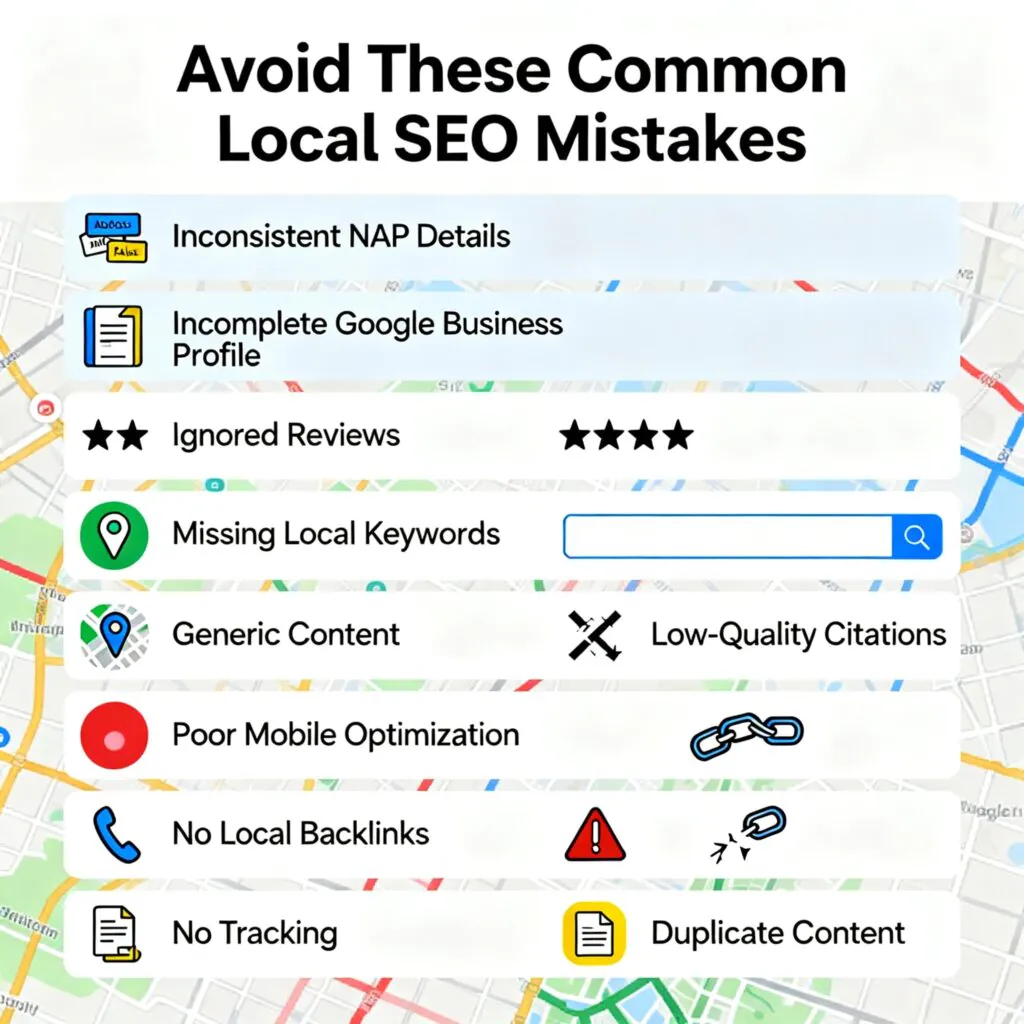
The common local SEO mistakes to avoid are listed below:
Inconsistent NAP Information Across Platforms
Business owners frequently undermine their local search rankings by displaying different names, addresses, or phone numbers across Google Business Profile, social media, directories, and their website, which confuses search engines and erodes customer trust. Search algorithms interpret these inconsistencies as separate entities rather than one business, directly damaging your local pack visibility and map rankings.
Neglecting Google Business Profile Optimization
Many businesses claim their Google Business Profile but fail to complete critical elements like business categories, operating hours, service descriptions, and regular photo updates, leaving potential customers with incomplete information while competitors gain visibility. An unoptimized profile with sparse details, outdated images, and no posts signals inactivity to Google’s algorithm, pushing your business down in local search results.
Ignoring Customer Reviews and Reputation Management
Businesses that don’t actively encourage reviews, respond to customer feedback, or address negative comments lose significant ranking power since Google weighs review quantity, recency, and engagement as key local ranking factors. Each unanswered review represents missed opportunities to demonstrate customer service quality, build trust, and incorporate natural keywords that improve search visibility.
Missing or Poorly Optimized Local Keywords
Generic keywords without geographic modifiers, like “plumber” instead of “emergency plumber in Denver,” prevent businesses from capturing high-intent local searches where customers are ready to purchase. Your website content, meta descriptions, headers, and service pages must naturally incorporate city names, neighborhood terms, and location-specific phrases that match how nearby customers actually search.
Lack of Location-Specific Content
Websites with only generic service descriptions that could apply to any city fail to establish local relevance, missing opportunities to rank for neighborhood-specific searches and demonstrate community involvement. Creating dedicated pages for each service area, publishing local event sponsorships, featuring customer success stories from specific neighborhoods, and discussing regional industry trends builds the geographic signals search engines need.
Building Low-Quality or Irrelevant Local Citations
Submitting your business information to spammy directories, irrelevant industry platforms, or citation sources with poor domain authority wastes time and can actually harm your local SEO through association with low-quality sites. Focus on authoritative local directories, chamber of commerce listings, industry-specific platforms, and locally-recognized business associations that carry genuine weight with search algorithms.
Not Optimizing for Mobile and Voice Search
Since most local searches happen on mobile devices and voice assistants prioritize conversational queries like “where’s the nearest coffee shop open now,” businesses with slow mobile sites and content that doesn’t answer natural-language questions lose critical visibility. Your website must load quickly on smartphones, feature click-to-call buttons, display clear directions, and structure content to answer common question-based searches.
Overlooking Local Link Building Opportunities
Businesses that don’t pursue backlinks from local news sites, community blogs, chamber of commerce websites, local event pages, and regional business partnerships miss powerful ranking signals that demonstrate community integration. One quality link from a respected local newspaper or university website carries more local SEO value than dozens of generic directory listings.
Failing to Track and Analyze Local SEO Metrics
Operating without monitoring Google Business Profile insights, local keyword rankings, citation accuracy, website traffic from local searches, and conversion rates from different geographic areas leaves you blind to what’s working and what needs improvement. Regular analysis reveals which neighborhoods drive the most customers, which keywords convert best, which citations need updating, and where competitors are outperforming you.
Using Duplicate Content Across Multiple Locations
Multi-location businesses that copy-paste identical service descriptions across different location pages with only the city name changed create thin content that search engines devalue or filter out entirely. Each location page requires unique content reflecting specific neighborhood characteristics, local customer testimonials, area-specific services, distinctive staff information, and genuine local photos that prove a legitimate presence.
Future Trends in Local SEO
The future trends in local SEO are listed below:
AI-Powered Search and Generative Results
Artificial intelligence now shapes how users find local information. Search engines generate direct answers, summaries, and recommendations at the top of results, reducing the need for clicks. Businesses must optimize for featured snippets, FAQ schema, and conversational content that AI can extract and display. Google’s Search Generative Experience (SGE) prioritizes well-structured, informative listings that directly answer specific local queries, changing how customers discover services within search results.
Hyper-Local and Neighborhood-Level Targeting
Search algorithms are moving beyond city-wide targeting to focus on neighborhood and district-level relevance. Businesses that create dedicated pages for specific communities, use local keywords, and publish neighborhood-based content gain higher visibility. Success now depends on addressing micro-communities instead of treating an entire city as a single location.
Voice and Visual Search Dominance
Voice assistants and visual recognition tools are redefining how customers find local businesses. Queries such as “find Italian restaurants near me” or “show me pet groomers open today” require content optimized for natural language and visual indexing. Businesses should write in conversational tones, include detailed alt text, add geographic metadata to images, and maintain rich media in their Google Business Profile to perform well in voice and image searches.
Google Business Profile as the Primary Digital Storefront
Google Business Profile is evolving into a complete digital storefront where customers can book appointments, message staff, view products, and make purchases without leaving Google. Businesses that actively update their profiles with current offers, menus, photos, and posts will attract more engagement. Treating the profile as a central hub, not a secondary listing, is now essential for customer acquisition.
Increased Importance of E-E-A-T for Local Businesses
Google’s focus on Experience, Expertise, Authoritativeness, and Trustworthiness (E-E-A-T) is expanding into local rankings. Businesses must prove real expertise through professional credentials, case studies, and transparent business details. Publishing staff bios, showcasing certifications, and earning positive reviews demonstrate reliability. Active community involvement also strengthens trust signals and authority in local results.
Integration of Augmented Reality and Location-Based Services
Augmented reality is reshaping local discovery by allowing users to preview businesses, view real-time availability, and explore products through 3D visualizations. Features like 360-degree tours and AR-compatible content increase engagement. Businesses that adopt these technologies will capture attention from tech-oriented customers seeking immersive local experiences.
Zero-Click Searches and Direct Information Display
Search engines now deliver answers directly within the results page, leading to fewer website visits. Knowledge panels, local packs, and instant answers display key business details without additional clicks. To remain visible, businesses must fully optimize their profiles, use structured data, and create content tailored for featured snippets and direct display formats.
Sustainability and Social Responsibility as Ranking Factors
Search algorithms are starting to reward businesses that demonstrate sustainability, ethical practices, and community engagement. Highlighting eco-friendly initiatives, local partnerships, and charitable involvement not only builds trust with users but may also enhance local ranking performance. Transparency about environmental and social commitments now plays a measurable role in local SEO success.
Multi-Platform Local Presence Management
Local search visibility no longer depends solely on Google. Businesses must manage consistent, optimized profiles across Apple Maps, Bing, Amazon Alexa, social networks, and niche directories. Each platform requires tailored optimization to match its unique audience and algorithm. Coordinated management across multiple ecosystems ensures a stronger brand presence and higher visibility where customers actually search.
Predictive Search and Behavioral Anticipation
Search engines increasingly anticipate what users want before they search. By analyzing location history, time of day, weather, and search patterns, algorithms suggest businesses that fit current needs. Maintaining accurate hours, updating real-time availability, and aligning content with seasonal trends help algorithms predict when and how users may need specific services.
Privacy-First Local Targeting and Consent-Based Marketing
Growing privacy regulations and the decline of third-party cookies are reshaping local targeting. Businesses must shift toward consent-based marketing that respects user privacy while still delivering relevant experiences. Building first-party relationships, using privacy-compliant tracking, and offering value-based incentives for data sharing will define future local SEO strategies.
Video Content for Local Discovery
Short-form video is becoming a dominant way for customers to discover local businesses. Platforms like YouTube, Google, and social media highlight video content in both standard and map search results. Businesses should create short, authentic videos featuring customer stories, service demonstrations, and behind-the-scenes insights. Optimizing videos with local keywords and geographic tags helps them appear in visual and local searches alike.
How To Learn Local SEO?
Mastering Local SEO requires a balance of theory, real-world application, and constant adaptation to algorithm changes and evolving digital platforms. The following structured paths help build a complete understanding of Local SEO from fundamentals to advanced strategy.
1. Build a Strong SEO Foundation
Before focusing on local tactics, understand core SEO principles. Learn how search engines crawl, index, and rank content. Study keyword research, on-page optimization, link building, and technical SEO. Familiarize yourself with key terms such as SERPs, backlinks, crawlability, and domain authority. This foundation helps you recognize which elements Local SEO enhances or modifies. Google’s Search Engine Optimization Starter Guide is a good entry point for developing essential SEO knowledge.
2. Study Google’s Official Documentation
Google provides the most accurate and up-to-date information about local search. Explore the Google Business Profile Help Center to understand verification, photo standards, review policies, and business information guidelines. Review Google’s Guidelines for Representing Your Business on Google to ensure compliance with name conventions, service area settings, and category usage. Follow the Google Search Central Blog and the Google Business Profile Community to stay informed about updates, new features, and official announcements. Relying on official resources prevents outdated or speculative learning.
3. Take Structured Online Courses
Online learning platforms such as Coursera, LinkedIn Learning, Udemy, and Semrush Academy offer Local SEO courses for different experience levels. Choose courses updated within the last year that include practical exercises, real business examples, and quizzes. Certifications from recognized instructors or industry practitioners can demonstrate your expertise to employers or clients.
4. Follow Leading SEO Publications
Stay informed through trusted SEO publications. Search Engine Land, Moz Blog, BrightLocal, Sterling Sky, Search Engine Journal, and Whitespark publish in-depth articles, case studies, and ranking factor analyses. Subscribe to their newsletters to receive timely updates. Consistent reading helps you track new algorithm trends and proven tactics across industries.
5. Engage with Local SEO Communities
Join practitioner communities where professionals share experiences and discuss challenges. Participate in the Google Business Profile Community Forum, the Local SEO subreddit, and dedicated Facebook groups. Follow Local SEO experts on platforms like X (formerly Twitter) using hashtags such as #LocalSEO. Active participation exposes you to diverse viewpoints, real-world problem-solving, and early detection of emerging trends.
6. Study Case Studies and Industry Research
Analyze documented Local SEO campaigns to understand what works in real markets. Review the Local Search Ranking Factors report and BrightLocal’s Consumer Review Survey for data-driven insights. Study agency case studies to see how specific tactics, timeframes, and strategies lead to measurable results. These examples translate theory into an actionable strategy.
7. Apply What You Learn
Practical experience is essential. If you own a business, apply Local SEO tactics directly. Otherwise, volunteer to optimize a friend’s business or local nonprofit. Track every action, from audits and citations to ranking changes. Real-world projects reveal challenges such as inconsistent listings, review generation, and GBP verification issues, building valuable hands-on experience.
8. Master Essential Local SEO Tools
Learn to use Google Business Profile Insights, Google Search Console, and local rank tracking tools like BrightLocal or Local Falcon. Understand citation management platforms such as Yext or Moz Local. Explore review monitoring tools that aggregate feedback across platforms. Use backlink analysis software like Ahrefs or Moz to evaluate local link profiles. Proficiency with these tools allows for efficient analysis and better decision-making.
9. Attend Webinars and Conferences
Join webinars and events hosted by Local SEO experts. Conferences like LocalU, MozCon, SearchLove, and Pubcon include dedicated local search sessions. Many webinars are free and include replays for future viewing. These sessions provide access to real-time insights from experienced practitioners and exposure to emerging strategies.
10. Analyze Competitor Strategies
Study top-performing local businesses to identify patterns that drive success. Review their Google Business Profiles for completeness, photo quality, and posting frequency. Examine their websites for location page structure, content depth, and structured data use. Use backlink and citation tools to uncover partnerships and local linking tactics. Competitive analysis reveals actionable opportunities and helps you refine your own approach.
11. Experiment and Test Hypotheses
Adopt a scientific mindset. Form hypotheses about ranking improvements and test them systematically. For example, apply specific optimizations to some business locations while keeping others as controls. Record all variables and results to identify what genuinely affects performance. Sharing experiment results with the community contributes to collective learning and builds analytical skills.
12. Earn Professional Certifications
Certifications validate knowledge and demonstrate professional commitment. Google offers certifications in Analytics and Ads that complement Local SEO work. HubSpot Academy and Semrush Academy provide additional credentials focused on SEO and digital marketing. These structured learning paths enhance credibility and professional growth.
13. Understand Local Consumer Behavior
Local SEO success depends on understanding how customers search and make decisions. Study user behavior, review influence, and mobile search habits. Learn which factors, such as responsiveness, reputation, or proximity affect conversions. Integrate these insights into your optimization strategy to align with customer expectations and search intent.
14. Stay Updated on Algorithm Changes
Google frequently updates its local search algorithms. Track updates through industry news, community discussions, and ranking data. When updates occur, analyze your results to understand what changed. This awareness helps you adjust strategies proactively and avoid outdated practices.
15. Learn Complementary Skills
Expand beyond SEO to strengthen your capabilities. Learn conversion rate optimization, basic graphic design, and reputation management. Understand data visualization, analytics, and paid search integration. These additional skills help you execute comprehensive digital strategies that improve both visibility and conversions.
16. Seek Mentorship and Peer Collaboration
Learning accelerates when guided by experienced practitioners. Find mentors who have managed successful Local SEO campaigns and seek their feedback on your strategies. Join mastermind groups with peers to exchange ideas, troubleshoot challenges, and stay accountable. Collaboration enhances understanding and supports professional growth.
17. Maintain a Continuous Learning Habit
Local SEO evolves constantly. Dedicate regular time to reading, testing, and refining your skills. Keep organized notes and a personal knowledge library of articles, tools, and experiments. Treat learning as an ongoing process rather than a one-time effort. Consistent learning ensures long-term success in a rapidly changing search landscape.