On this page
- Claude vs ChatGPT: What’s the Difference?
- What Is Claude AI?
- What Is ChatGPT?
- Key Differences Digital Marketers Should Know
- Claude vs ChatGPT for Content Creation
- Blog Posts and Long-Form Content
- SEO Content Briefs and Content Optimization
- Website Copy and Landing Pages
- Email Marketing Copy
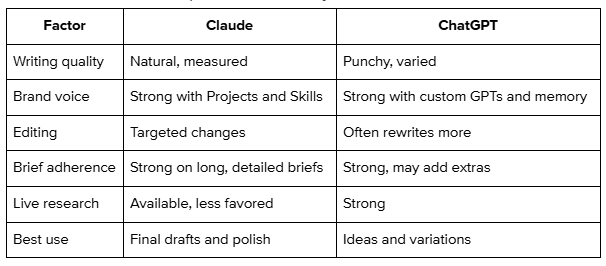
- Content Creation Comparison Summary
- Claude vs ChatGPT for Social Media Marketing
- Social Media Content Calendars
- LinkedIn Posts, Instagram Captions, and Short-Form Content
- Repurposing Existing Content
- Campaign Ideas and Audience Engagement
- Practical Prompt for Platform-Specific Content
- Claude vs ChatGPT for SEO and Search Marketing
- Keyword Clustering and Search Intent
- On-Page SEO and Content Audits
- SEO Reporting and Performance Analysis
- The Need for External SEO Data and Fact-Checking
- Claude vs ChatGPT for Business Strategy
- Market Research and Competitor Analysis
- Customer Personas and Positioning
- Campaign Planning and Marketing Strategy
- Marketing Budget and Resource Planning
- The Limits of AI Strategy Work
- Claude vs ChatGPT for Sales and Lead Generation
- Lead Qualification and Customer Segmentation
- Sales Emails and Outreach Personalization
- Sales Scripts and Objection Handling
- CRM Data Analysis and Sales Reporting
- Privacy, Consent, Accuracy, and Human Review
- Claude vs ChatGPT for PPC and Paid Advertising
- Google Ads and Paid Social Copy
- Ad Variations and A/B Testing Ideas
- Landing-Page Conversion Optimization
- Campaign Performance Analysis
- Claude API Pricing vs ChatGPT: What Should Marketers Consider?
- Consumer Subscription Plans
- API Pricing and Pay-as-You-Go Usage
- Team and Enterprise Requirements
- How to Evaluate Total Cost
- What Do Users Say About Claude vs ChatGPT for Business?
- Common Themes
- What Reddit Discussions Show
- Why Anecdotes Do Not Prove Superiority
- Can Digital Marketers Use Claude and ChatGPT Together?
- When Two Subscriptions Justify the Cost
- Example Workflow From Planning to Reporting
- Claude vs ChatGPT: Which Is Better for Digital Marketers?
- Best Fit by Marketing Task
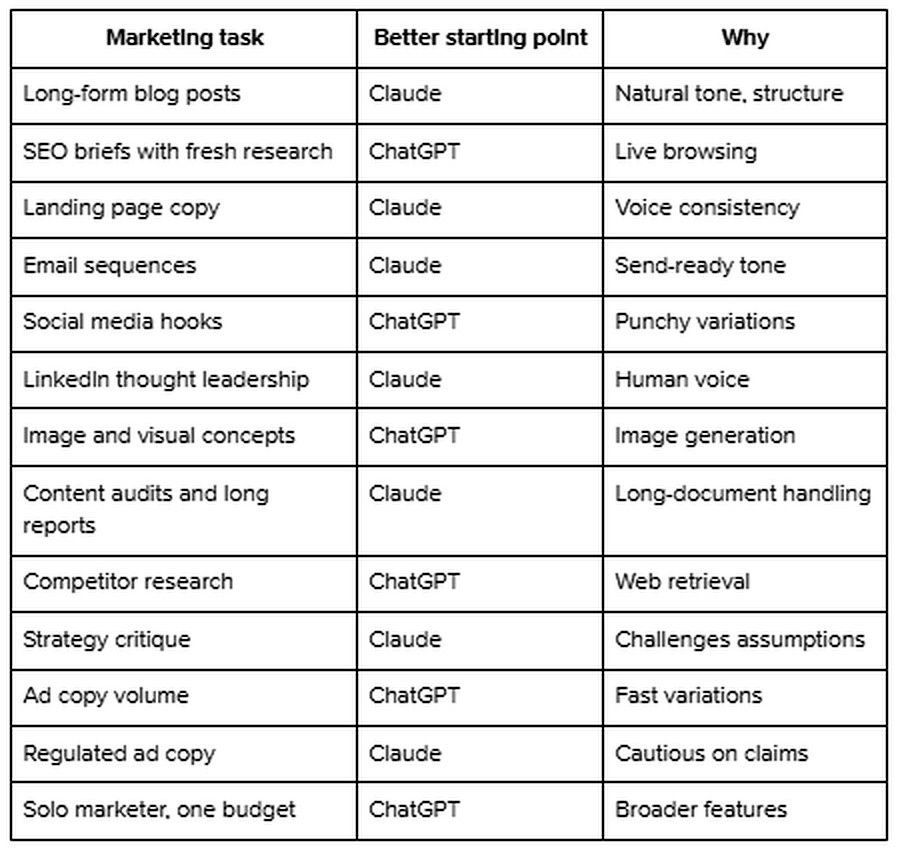
- Decision Matrix
- Test Both on the Same Real Task
- Frequently Asked Questions
- Is Claude better than ChatGPT for marketing?
- Which is better for content creation: Claude or ChatGPT?
- Is Claude or ChatGPT better for social media marketing?
- Can Claude and ChatGPT help with business strategy?
- Which is better for sales and lead generation?
- Is Claude API cheaper than ChatGPT?
- Can digital marketers use Claude and ChatGPT for free?
- What is the best way to use Claude and ChatGPT together?
Claude and ChatGPT are the two AI assistants digital marketers compare most often. Both draft copy, summarize research, analyze data, and speed up repetitive work, yet they behave differently. Choosing between them depends on the task, the workflow, and the features your team needs.
Claude tends to excel at long-form writing, brand voice, careful editing, and analysis of long documents. ChatGPT tends to excel at brainstorming, punchy hooks, image generation, live web research, and an all-in-one feature set. For content creation, Claude usually needs fewer edits, while ChatGPT produces more angles faster. For social media, ChatGPT often wins on hooks and volume, while Claude suits thought leadership. For SEO, both can cluster keywords and audit pages, but neither replaces external SEO data or fact-checking. For business strategy and sales, both analyze supplied information and generate hypotheses, so human review, privacy compliance, and validated research remain essential. For paid advertising, ChatGPT offers fast variations, and Claude stays cautious on claims.
Pricing is similar at the entry level, with both charging about $20 per month for individual plans and $100 to $200 for power tiers. API usage is billed separately from subscriptions, so verify current rates before budgeting.
Anecdotal user reports do not prove universal superiority. Many marketers get the best results by using both tools in a complementary workflow. This guide compares each use case, shows a decision matrix, and recommends testing both on the same real task. Read on to match each tool to the marketing job it handles best.
Claude vs ChatGPT: What’s the Difference?
What Is Claude AI?
Claude is Anthropic’s AI assistant. It is known for careful reasoning, natural writing, and strong handling of long inputs.
- Long-document strength: Claude can read reports, transcripts, audits, and brand guidelines in one pass. This helps marketers who work from large source files.
- Projects: Claude Projects store reference files and standing instructions. A team can save its style guide, audience notes, and past examples so every chat starts with the right context.
- Skills and Artifacts: Skills package repeatable instructions, such as a “remove AI clichés” editing routine. Artifacts let Claude produce documents, pages, and tools in a side panel.
- No image generation: Claude does not create images. Marketers who need visuals must use another tool.
What Is ChatGPT?
ChatGPT is OpenAI’s AI assistant. It bundles many capabilities into one product.
- Multimodal features: ChatGPT handles text, images, voice, and file analysis. Solo marketers can draft a post and create its graphic in the same place.
- Web research: Browsing and deep research tools pull current information. This helps with competitor checks, trend scans, and SEO briefs.
- Custom GPTs and agents: Teams can build reusable assistants for tasks such as ad copy or reporting. Agent features can carry out multi-step work.
- Broad ecosystem: Plugins, connectors, and integrations make ChatGPT easy to slot into varied workflows.
Key Differences Digital Marketers Should Know
- Writing style: Claude usually produces calmer, more natural prose that needs fewer edits. ChatGPT usually produces punchier hooks and more varied angles. The best choice depends on whether you value polish or idea volume.
- Editing behavior: Claude tends to change only what you ask. ChatGPT more often rewrites the whole passage, which can erase lines you liked. Precise edits matter when a client has approved most of the copy.
- Visuals: ChatGPT generates images and Claude does not. For solo creators, this single feature can decide the purchase.
- Live research: ChatGPT’s browsing and deep research are widely preferred for retrieval-heavy tasks. Claude can search the web too, but many testers still lean on ChatGPT for fresh data.
- Handling uncertainty: Claude more often says “I’m not sure” and lists possible causes. ChatGPT more often commits to one answer. Cautious answers help in analytics, while confident answers help in brainstorming.
- Pricing structure: Both offer free tiers, $20 individual plans, and $100 to $200 power tiers. Limits and features differ, so compare them on real work.
These are tendencies, not guarantees. Both products update often, so retest every few months.
Claude vs ChatGPT for Content Creation
Content creation is where marketers feel the difference most. A common summary says ChatGPT favors speed and volume, while Claude favors quality and brand consistency. That matches many reports, but your own tests should decide.
Blog Posts and Long-Form Content
- Structure and flow: Claude usually holds a clear structure across a 2,000-word draft. It rarely repeats itself or inflates conclusions.
- Ideation: ChatGPT generates many outlines and angles quickly. It suits the brainstorming stage.
- Practical split: Ideate in ChatGPT, then draft and edit in Claude. This uses each tool where it is strongest.
- Original input: Feed either tool your research, expert quotes, and examples. Drafts without original insight read like every competing article.
- Human review: Fact-check claims, add real experience, and adjust tone before publishing.
SEO Content Briefs and Content Optimization
- Brief components: A strong brief includes search intent, primary and secondary keywords, entities, headings, questions to answer, and internal links.
- Claude’s edge: Claude produces cleanly organized briefs and follows detailed templates closely.
- ChatGPT’s edge: ChatGPT can pull fresher entities and competitor context through live research. Testers have reported this gap in brief-writing tasks.
- Optimization workflow: Paste your draft, the target keyword, and the outlines of top-ranking pages. Ask the tool to flag missing subtopics, weak headings, and thin sections.
- Net approach: Build the brief structure in Claude and fill the live research gaps with ChatGPT.
Website Copy and Landing Pages
- Clarity and proof: Landing pages need a clear offer, proof, objection handling, and one call to action. Claude handles these frameworks consistently.
- Headline volume: ChatGPT generates many headline variations quickly, which helps early testing.
- Inputs that matter: Give both tools the audience, offer, objections, tone rules, and legal limits before asking for copy.
- Message match: Ask each tool to check that the page matches the ad or email that sends traffic to it.
Email Marketing Copy
- Voice precision: Email rewards brevity and a human tone. Testers have found Claude’s cold emails closer to send-ready, while ChatGPT’s versions often needed trimming.
- Subject lines and variants: ChatGPT is useful for large batches of subject lines and A/B variants.
- Sequence consistency: Claude helps keep tone, pacing, and messaging aligned across a full nurture sequence.
- Compliance: Review every email for unsubscribe language, claims, and consent rules.
Content Creation Comparison Summary

Free download
When customers ask AI for a recommendation, does your business come up?
How to Get Your Business Recommended by ChatGPT and Google AI
- A 10-minute self-test to see what ChatGPT, Gemini, Perplexity and Google AI Overviews say about you
- 10 practical actions that make your business easier for AI tools to find, understand and trust
- A one-page action plan for your first week, first month and beyond
PDF · 7 pages · printable
Claude vs ChatGPT for Social Media Marketing
Social Media Content Calendars
- Calendar structure: Both tools build monthly calendars from a brand profile, audience, and goals. Ask for a table with date, platform, format, hook, call to action, and metric.
- ChatGPT’s strength: It generates many post ideas by theme at high speed.
- Claude’s strength: It keeps a calendar aligned with a long brand document and a defined voice.
- Review step: Check dates, holidays, and platform limits yourself.
LinkedIn Posts, Instagram Captions, and Short-Form Content
- Hooks: ChatGPT often produces stronger scroll-stopping first lines. It suits Instagram, X, and short videos.
- Thought leadership: Claude often writes more natural LinkedIn posts, where a human voice builds trust.
- Volume versus craft: One practitioner summary advises using ChatGPT when you need dozens of captions fast and Claude when you are writing one piece that represents the brand.
- Platform rules: Specify character counts, hashtag limits, and tone for each platform.
Repurposing Existing Content
- Long sources: Claude handles webinars, podcasts, and whitepapers without losing the central argument.
- Visual assets: ChatGPT helps when each post also needs a graphic or image concept.
- Repurposing map: Turn one article into a LinkedIn post, a thread, a short video script, an email, and a carousel outline.
- Quality control: Ask for different angles per platform instead of the same message reformatted.
Campaign Ideas and Audience Engagement
- Concept generation: Both tools produce campaign themes, hashtags, polls, and community prompts.
- Specificity: Tie requests to one audience pain point and one measurable goal. Generic prompts produce generic ideas.
- Engagement tactics: Ask for reply prompts, comment starters, and user-generated content ideas.
- Testing: Treat ideas as hypotheses, then measure engagement before scaling.
Practical Prompt for Platform-Specific Content
You are a social media strategist for [brand], which sells [product] to [audience]. Our voice is [three adjectives]. Using the blog post below, create content for four platforms. For LinkedIn, write one 150-word post with a strong first line and a question at the end. For Instagram, write one caption under 125 words with three hashtags. For X, write a five-post thread. For a short video, write a 30-second script with hook, value, and call to action. Avoid clichés and unverified claims. After each draft, add one sentence explaining the angle.
[Paste blog post]
Claude vs ChatGPT for SEO and Search Marketing
Keyword Clustering and Search Intent
- Clustering: Both tools group keywords by topic and label intent as informational, commercial, or transactional.
- Input format: Paste exports from Ahrefs, Semrush, or Google Search Console. Ask for clusters, a primary keyword per cluster, and a suggested page type.
- Intent checks: AI infers intent from patterns, not from live rankings. Compare each result against the real search results page.
- Cannibalization: Ask the tool to flag clusters that could compete with existing pages.
On-Page SEO and Content Audits
- Long inputs: Claude handles crawl exports, page copy, and heading structures well.
- Workflow tasks: ChatGPT suits tool-based workflows and automations.
- Practitioner view: In a Reddit discussion on AI tools for SEO, commenters said ChatGPT works well for workflows and tools, while Claude works well with long documents such as audits. Others argued the pipeline feeding the model matters more than the model.
- Audit checklist: Ask for title tag, meta description, heading, internal link, schema, and content gap recommendations per page.
SEO Reporting and Performance Analysis
- Summaries: Both tools turn exports into plain-language summaries and likely causes of traffic changes.
- Test results: A 30-question analytics test by a reporting-tool vendor found Claude slightly ahead overall, stronger at attribution and cross-channel reasoning, and more willing to admit uncertainty. ChatGPT was stronger on ad platform specifics. Treat this as one data point.
- Report format: Ask for findings, evidence, risks, and next actions in separate sections.
The Need for External SEO Data and Fact-Checking
- Missing data: Neither tool knows your real search volumes, keyword difficulty, backlinks, or rankings unless you supply data or connect a source.
- Invented details: AI can fabricate statistics, sources, and competitor claims.
- Verification rule: Check every number, quote, and citation before publishing.
- Best practice: Use SEO platforms for data and AI for analysis, drafting, and organization.
Claude vs ChatGPT for Business Strategy
Market Research and Competitor Analysis
- Supplied material: Both tools summarize competitor pages, reviews, and reports you provide.
- Live retrieval: ChatGPT is stronger when you need current web information.
- Synthesis: Claude is stronger when you need to combine many long documents into one view.
- Validation: Treat outputs as hypotheses and confirm them with primary research or paid market data.
Customer Personas and Positioning
- Evidence-based personas: Provide survey results, interview transcripts, CRM notes, and support tickets. Ask for personas with jobs to be done, objections, and buying triggers.
- Claude’s tendency: It stays close to supplied evidence.
- ChatGPT’s tendency: It offers more creative positioning options.
- Positioning test: Ask each tool to write three positioning statements, then test them with real customers.
Campaign Planning and Marketing Strategy
- Plan components: Request objective, audience, message, channel mix, timeline, and success metrics.
- Red-team step: Ask the tool to argue against its own plan. This exposes weak assumptions early.
- Practitioner example: One UK marketing agency founder reported building a strategy sounding board inside Claude Projects, saying he trusts Claude to challenge him more than ChatGPT.
- Scenario planning: Ask for best, expected, and worst cases with the assumptions listed.
Marketing Budget and Resource Planning
- Budget splits: Provide historical spend and results. Ask for allocation scenarios by channel.
- Staffing needs: Ask for workload estimates by campaign phase.
- Visible assumptions: Require a list of assumptions so a human can audit the math.
- Finance review: Have a finance lead approve numbers before any commitment.
The Limits of AI Strategy Work
Both tools analyze supplied information and develop strategic hypotheses. Neither replaces validated market research, customer interviews, or financial review.
Claude vs ChatGPT for Sales and Lead Generation
Lead Qualification and Customer Segmentation
- Scoring logic: Provide anonymized lead attributes and your qualification criteria. Ask for scoring rules and segment definitions.
- Segmentation: Both tools can group leads by industry, behavior, or intent.
- Validation: Have sales leadership review logic before it affects a live process.
- Bias check: Ask the tool to identify criteria that could unfairly exclude good leads.
Sales Emails and Outreach Personalization
- Tone: Claude often produces outreach that sounds less templated.
- Volume: ChatGPT is quick at generating many variations.
- Real personalization: Use facts you collected, such as a recent post or product launch. Do not let AI guess prospect details.
- Follow-ups: Ask for a three-step sequence with different value angles.
Sales Scripts and Objection Handling
- Call scripts: Both tools draft discovery questions, demo flows, and closing language.
- Objection library: Provide your top ten real objections and supporting case studies. Ask for responses grounded in that evidence.
- Role-play: Use either tool to practice calls and get feedback.
- Compliance: Remove claims you cannot prove.
CRM Data Analysis and Sales Reporting
- Pipeline analysis: Upload exports to find stalled stages, win-rate patterns, and follow-up gaps.
- Claude’s fit: It handles large exports and long notes well.
- ChatGPT’s fit: Its data analysis tools help with charts and calculations.
- Reporting: Ask for a weekly summary with risks, wins, and recommended actions.
Privacy, Consent, Accuracy, and Human Review
- Privacy: Sales data often contains personal information. Remove unnecessary personal data before uploading.
- Consent: Follow GDPR, CAN-SPAM, and local rules for outreach.
- Plan choice: Business and enterprise plans typically offer stronger data controls. Check each vendor’s current terms.
- Accuracy: AI can misstate facts about a prospect or product.
- Human review: A person should approve every outbound message and every AI-derived lead score.
Claude vs ChatGPT for PPC and Paid Advertising
Google Ads and Paid Social Copy
- Constraints: Both tools write headlines and descriptions within character limits. Provide the landing page, keywords, offer, and policy rules.
- ChatGPT’s tendency: It often produces edgier hooks.
- Claude’s tendency: Testers noted it stays safer around claim restrictions. This matters in finance, health, and other regulated industries.
- Policy check: Review all copy against platform ad policies.
Ad Variations and A/B Testing Ideas
- One-variable tests: Ask for variations that change a single element, such as the benefit, proof point, or call to action.
- Hypotheses: Ask each tool to state what each variation tests and what result would confirm it.
- Test plans: Both can propose sample sizes and run times, but your ad platform decides the winner.
- Volume use: ChatGPT suits large variation batches, and Claude suits careful, on-brand refinement.
Landing-Page Conversion Optimization
- Page critique: Paste landing page copy and ask for message-match issues, unclear value propositions, missing proof, and friction points.
- Claude’s output: It tends to give structured critiques.
- ChatGPT’s output: It can pair critiques with layout or image ideas.
- Prioritization: Ask for fixes ranked by expected impact and effort.
Campaign Performance Analysis
- Anomaly detection: Export campaign data and ask for wasted spend, anomalies, and promising segments.
- Platform knowledge: Reviewers have found ChatGPT stronger on ad platform specifics, so it may explain settings better.
- Verification: Confirm every recommendation inside Google Ads, Meta, or your analytics platform before changing budgets.
- Attribution caution: Ask each tool to state its confidence and the data limits behind each conclusion.
Claude API Pricing vs ChatGPT: What Should Marketers Consider?
Prices change often, and sources disagree on some tiers. Verify everything on the official pricing pages before publication.
Consumer Subscription Plans
- Claude Free: Limited usage, suited to testing.
- Claude Pro: About $20 per month, or about $17 per month billed annually.
- Claude Max: $100 or $200 per month, for heavy users who hit Pro limits.
- Claude Team: About $25 per seat for standard and $125 for premium seats.
- Claude Enterprise: Custom pricing with security and compliance features.
- ChatGPT Free and Go: Free is $0. Go is a low-cost tier, listed between about $5.50 and $8 depending on the source. Ads have appeared on Free and Go in the US.
- ChatGPT Plus: $20 per month.
- ChatGPT Pro: Tiers at $100 and $200 per month, and some sources list a $500 tier.
- ChatGPT Business: About $25 per user monthly, or $20 billed annually, with a two-seat minimum.
- ChatGPT Enterprise: Custom pricing.
API Pricing and Pay-as-You-Go Usage
- Separate products: A ChatGPT subscription is not OpenAI API usage. A Claude subscription is not Anthropic API usage. Each API bills separately.
- Token billing: APIs charge per million tokens, with different input and output rates.
- Claude examples: Published rates have run from about $1 input and $5 output per million tokens for Haiku, to $3 and $15 for Sonnet, and $5 and $25 for Opus.
- Discounts: Anthropic offers batch processing at about 50 percent off for asynchronous work, plus prompt caching that can reduce repeated input costs.
- OpenAI rates: These vary widely by model, so compare the exact models you plan to use.
- Marketing use cases: API access matters for automations such as bulk product descriptions, ad generation, and report pipelines.
Want this checked on your own site? Get my free social media audit
Team and Enterprise Requirements
- Admin controls: Check user management, single sign-on, and audit logs.
- Data policies: Confirm retention rules and whether your content is used for model training.
- Connectors: Verify integrations with Google Workspace, Microsoft 365, Slack, and your CRM.
- Usage limits: Check per-seat limits, since heavy users may need premium seats.
- Contracts: Get enterprise terms in writing.
How to Evaluate Total Cost
- Seats: Count everyone who needs access.
- Limits: Track how often your team hits caps. One practitioner warned that agencies managing many clients may find Claude’s message limits frustrating.
- API spend: Estimate monthly token volume for automations.
- Editing time: Measure minutes saved or lost per draft. Cheaper output that needs heavy rewriting costs more.
- Replacement tools: Count image generators, research tools, or writing tools the subscription could replace.
- Trial method: Run a two-week trial and log real usage before committing.
What Do Users Say About Claude vs ChatGPT for Business?
Common Themes
- Output quality: Many marketers say Claude writes more naturally. Many say ChatGPT is better for ideas and speed.
- Workflow fit: A UK marketing agency CEO described in a business-press essay said Claude is a better writer in his opinion. He still uses ChatGPT for image generation, since Claude does not create images, and keeps it as a backup because of Claude outages.
- Integrations: One analytics comparison noted that ChatGPT’s connector support improved quickly in 2026 but sometimes produced tool-call errors that Claude handled more smoothly.
- Cost and limits: Message caps on Claude and tier confusion on ChatGPT come up often.
- Hybrid habits: Many practitioners describe drafting in Claude and polishing hooks or meta descriptions in ChatGPT.
What Reddit Discussions Show
- Split opinions: In a Reddit thread on AI tools for SEO, one commenter used ChatGPT for content writing and Claude for technical work. Another said the pipeline feeding the model matters more than the model choice.
- Claude migration: A poster noted seeing more SEO consultants moving toward Claude, while also observing that Claude seemed to have stricter rate limits.
- Common advice: Pick the model by job, and invest in prompts, data, and process.
Why Anecdotes Do Not Prove Superiority
- Variable inputs: Results depend on prompts, plan tier, model version, industry, and personal taste.
- Fast change: Models update month to month, so old opinions expire.
- Selection bias: People who post online often have strong experiences, good or bad.
- Best use: Treat user reports as clues about what to test, not as proof.
Can Digital Marketers Use Claude and ChatGPT Together?
Yes. Many marketers route tasks by strength. A common pattern among practitioners is Claude for drafts and ChatGPT for hooks and meta descriptions.
When Two Subscriptions Justify the Cost
- Cost: Two $20 plans cost about $40 per month.
- Worth it when: You publish weekly, need both long-form drafts and images, or lose hours rewriting weak output.
- Not worth it when: One tool already covers about 90 percent of your work.
- Middle path: Use one paid plan and the other tool’s free tier for occasional tasks.
Example Workflow From Planning to Reporting
- Research with ChatGPT: Gather current competitor pages, trends, and SERP features through live browsing. Export the sources.
- Strategy with Claude: Upload research, interviews, and brand guidelines. Ask for a campaign plan and challenge its assumptions.
- Briefs with Claude: Turn the plan into detailed briefs with intent, outline, and voice rules.
- Variations with ChatGPT: Generate headline, subject line, and ad variations.
- Drafting with Claude: Write and refine long-form content and email sequences.
- Visuals with ChatGPT: Create image concepts and social graphics.
- Reporting with either tool: Upload campaign data to both, compare their explanations, and verify numbers in your analytics platform.
- Human review: A marketer approves facts, claims, and brand fit at every stage.
Claude vs ChatGPT: Which Is Better for Digital Marketers?
Best Fit by Marketing Task
- Claude fits: Long-form content, brand voice, editing, document analysis, strategy critique, and regulated copy.
- ChatGPT fits: Brainstorming, hooks, image creation, live research, and high-volume variations.
- Both fit: Keyword clustering, persona drafting, campaign planning, and report summaries, with human verification.
Decision Matrix
Test Both on the Same Real Task
- Pick one task: Choose a landing page, a brief, or a monthly report.
- Use identical inputs: Same prompt, same data, same context.
- Score the results: Rate accuracy, voice, edit time, and usefulness.
- Repeat: Test two or three task types before deciding.
- Retest: Run the comparison again every few months as models change.
Disclosure: this article was drafted by Claude, which is made by Anthropic. Weigh its comparisons accordingly and test both tools yourself.
Frequently Asked Questions
Is Claude better than ChatGPT for marketing?
Neither wins every task. Claude is often preferred for writing quality, editing, and long documents. ChatGPT is often preferred for ideation, images, and live research. Match the tool to the job.
Which is better for content creation: Claude or ChatGPT?
Claude usually needs fewer edits for long-form and brand-voice work. ChatGPT is faster for outlines, hooks, and variations. Many teams draft in Claude and ideate in ChatGPT.
Is Claude or ChatGPT better for social media marketing?
ChatGPT tends to generate stronger hooks, more volume, and images. Claude tends to write more natural LinkedIn posts and holds tone steady across a calendar. Choose by platform and format.
Can Claude and ChatGPT help with business strategy?
Yes. Both analyze supplied documents, build personas, draft plans, and model budgets. They produce hypotheses, not validated research. Confirm key assumptions with real customer and market data.
Which is better for sales and lead generation?
Claude often writes more natural outreach and handles long CRM notes. ChatGPT is quick with variations and data analysis. Protect personal data, follow consent laws, and review everything before sending.
Is Claude API cheaper than ChatGPT?
It depends on the model and workload. Claude’s main models have been published from about 1/5 to 5/25 per million input and output tokens, while OpenAI’s rates vary by model. Compare exact models, caching, and batch discounts, and verify current pricing.
Can digital marketers use Claude and ChatGPT for free?
Yes. Both have free tiers with usage limits, which suit testing and light work. Daily professional use usually needs a paid plan. Check current limits, and note that ChatGPT’s free tier may show ads.
What is the best way to use Claude and ChatGPT together?
Route by strength. Use ChatGPT for live research, hooks, and images. Use Claude for strategy critique, long-form drafting, editing, and document analysis. Keep a human in charge of fact-checking and final approval.
Want this checked on your own site? Get my free social media audit
Free download
When customers ask AI for a recommendation, does your business come up?
How to Get Your Business Recommended by ChatGPT and Google AI
- A 10-minute self-test to see what ChatGPT, Gemini, Perplexity and Google AI Overviews say about you
- 10 practical actions that make your business easier for AI tools to find, understand and trust
- A one-page action plan for your first week, first month and beyond
PDF · 7 pages · printable

Written by
Shubhan SopariwalaSr. SEO Strategist, VASP Digital · London, Ontario
A SEO strategist with deep expertise in technical and semantic SEO, Shubhan combines data science principles with content marketing strategies to deliver comprehensive search optimization strategies.