
On this page
- Key takeaways
- What is a Digital Marketing Agency?
- What Does a Digital Marketing Agency Do for Small Businesses?
- 1. Improves Search Engine Rankings Through SEO
- 2. Manages Social Media Marketing
- 3. Runs Paid Advertising Campaigns
- 4. Creates Content That Attracts Customers
- 5. Builds and Optimizes Business Websites
- 6. Uses Email Marketing to Nurture Leads
- 7. Helps Local Businesses Attract Nearby Customers
- 8. Tracks Results and Measures Marketing Performance
- What Services Does a Digital Marketing Agency Offer?
- Search Engine Optimization (SEO)
- Social Media Marketing
- Pay-Per-Click Advertising (PPC)
- Content Marketing
- Website Design and Optimization
- Email Marketing
- Local SEO
- Analytics and Performance Tracking
- How Do Digital Marketing Agencies Work?
- 1. Business Discovery and Research
- 2. Strategy Development
- 3. Campaign Planning and Execution
- 4. Performance Tracking and Reporting
- 5. Optimization and Improvement
- What Are the Benefits of Hiring a Digital Marketing Agency for a Small Business?
- Specialized expertise:
- Time savings:
- Lower cost than hiring a team:
- Access to premium tools:
- Faster results and fewer mistakes:
- Scalability:
- Objective perspective:
- Data-backed decisions:
- Consistent brand presence:
- How Much Does a Digital Marketing Agency Cost for a Small Business?
- How to Choose the Right Digital Marketing Agency for Your Small Business?
- Define your goals first
- Review portfolios and case studies
- Read reviews and ask for references
- Ask about their process
- Check their expertise in your needed services
- Request transparent pricing
- Confirm reporting standards
- Be cautious with guarantees
- Look for ethical practices
- Assess communication and cultural fit
- Is a Digital Marketing Agency Worth It for a Small Business?
- FAQs
A digital marketing agency helps small businesses get found online, attract the right customers, and turn visitors into paying clients. It acts as an outsourced marketing team, combining SEO specialists, content writers, designers, web developers, paid media managers, and data analysts under one roof.
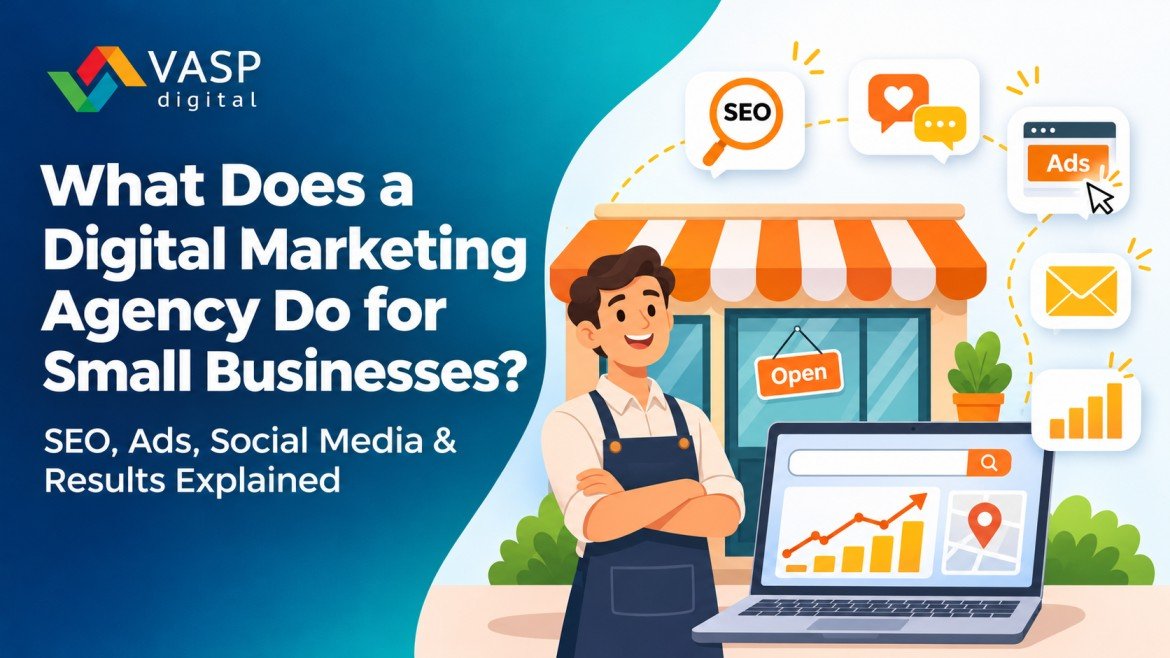
In practice, an agency improves search rankings through SEO, manages social media, runs paid advertising campaigns, creates helpful content, optimizes websites, nurtures leads through email marketing, and attracts nearby customers with local SEO. It also tracks performance with tools like Google Analytics so every dollar connects to a measurable result.
Agencies follow a clear process: business discovery, strategy development, campaign execution, performance reporting, and ongoing optimization. This structure keeps campaigns focused on goals such as more leads, calls, or online sales.
The main benefits include expert knowledge, time savings, access to premium tools, scalability, and data-backed decisions at a lower cost than building an in-house team. Most small businesses pay between $1,000 and $5,000 per month, depending on services and market competition.
This guide explains what agencies do, which services they offer, how they work, what they cost, and how to choose the right partner. It also answers a key question: is a digital marketing agency worth it for your small business?
What is a Digital Marketing Agency?
A digital marketing agency is a service company that plans, launches, and improves online marketing campaigns for other businesses. It combines strategy, creative work, technology, and data analysis under one team. Clients hire agencies to grow visibility, generate leads, and increase sales without building a marketing department from scratch.
Most agencies employ several types of specialists:
- SEO specialists improve search rankings and organic traffic.
- Content writers and editors produce articles, web copy, and email content.
- Graphic designers and video editors create visuals for ads, social posts, and websites.
- Web developers build and maintain fast, secure, mobile-friendly sites.
- Paid media managers run campaigns on Google Ads, Meta Ads, and similar platforms.
- Data analysts track performance and turn numbers into recommendations.
- Account managers coordinate the work and communicate with the client.
Agencies differ in scope. A full-service digital marketing agency covers every channel. A specialized agency focuses on one area, such as SEO, PPC, or social media. A local marketing agency concentrates on businesses that serve a specific city or region. Small businesses often start with a specialist or a local agency, then move to a broader partnership as they grow.
An agency is different from a freelancer and from an in-house team. A freelancer offers one skill set from one person. An in-house team belongs to your company and works only on your brand. An agency sits in between, offering multiple skills, shared tools, and flexible capacity at a predictable monthly cost.
What Does a Digital Marketing Agency Do for Small Businesses?
A digital marketing agency builds a measurable system that connects your business to people who are actively searching for what you sell. It researches your market, chooses the right channels, creates the assets, runs the campaigns, and refines them using performance data. That system supports every stage of the customer journey: awareness, consideration, decision, and loyalty.
The eight functions below describe where agencies create the most value for small businesses.
1. Improves Search Engine Rankings Through SEO
Search engine optimization (SEO) increases the visibility of your website in unpaid Google results. Roughly speaking, search engines try to match a person’s query with the most relevant, trustworthy, and useful page. An agency helps your pages become that match.
The work typically covers four areas:
- Keyword research identifies the exact phrases customers type, such as “emergency plumber near me” or “best accountant for freelancers.” Agencies group these phrases by search intent: informational, commercial, transactional, or navigational.
- On-page SEO aligns title tags, meta descriptions, headings, internal links, image alt text, and body content with each target query.
- Technical SEO ensures search engines can crawl, render, and index your site. It includes XML sitemaps, clean URL structures, schema markup, HTTPS, mobile usability, and Core Web Vitals such as loading speed and layout stability.
- Off-page SEO builds authority through backlinks from reputable websites, brand mentions, and digital PR.
SEO produces compounding returns. A well-optimized page can bring in qualified visitors for months or years without paying for each click. For a small business, that makes SEO one of the most cost-efficient long-term channels. It also supports user engagement, because pages written around real questions keep visitors reading, scrolling, and clicking deeper into the site.
2. Manages Social Media Marketing
Social media marketing builds brand awareness, community, and trust on platforms where your customers already spend time. An agency selects the right platforms for your audience, because a B2B consultant may thrive on LinkedIn while a boutique or restaurant may perform better on Instagram, Facebook, or TikTok.
Day-to-day tasks include:
- Creating a content calendar tied to promotions, seasons, and business goals
- Producing branded graphics, short videos, carousels, and Stories
- Writing captions with clear hooks and calls to action
- Using relevant hashtags and keywords so posts surface in platform search
- Responding to comments and direct messages quickly
- Monitoring engagement rate, reach, saves, shares, and follower growth
Engagement is the key signal on social platforms. Posts that earn comments, shares, and saves reach more people. An agency tests formats, posting times, and message styles to learn what your audience responds to. Social activity also supports SEO indirectly, since it spreads content, increases branded searches, and builds recognition that makes people more likely to click your listing later.
3. Runs Paid Advertising Campaigns
Paid advertising delivers immediate visibility by placing your business in front of people who match specific search terms, interests, locations, or behaviors. Agencies manage pay-per-click (PPC) campaigns on Google Ads, Microsoft Advertising, Meta Ads, LinkedIn Ads, and YouTube.
A well-run campaign involves several connected steps:
- Audience targeting narrows delivery by location, demographics, interests, search intent, and remarketing lists.
- Ad copywriting turns your offer into short, persuasive text that matches what the searcher wants.
- Landing page alignment sends clicks to a page that continues the promise made in the ad.
- Bid and budget management controls cost per click (CPC) and cost per acquisition (CPA).
- Conversion tracking records calls, form submissions, purchases, and bookings.
- Testing compares headlines, images, offers, and audiences to find the strongest combination.
From a search engine perspective, Google rewards relevance in paid ads through Quality Score, which looks at expected click-through rate, ad relevance, and landing page experience. Agencies improve all three, which lowers costs and improves ad positions. For small businesses with limited budgets, this optimization prevents wasted spend.
4. Creates Content That Attracts Customers
Content marketing attracts and educates potential customers by answering their questions before they ever speak to a salesperson. Agencies create blog posts, service pages, FAQs, videos, case studies, checklists, guides, newsletters, and infographics.
Strong content serves two audiences at once: people and search engines. For people, it is clear, helpful, and easy to scan. For search engines, it demonstrates experience, expertise, authoritativeness, and trustworthiness, often called E-E-A-T. Agencies build content around topic clusters, where one main page covers a broad subject and supporting articles explore related questions in detail. This structure helps search engines understand your topical authority and helps visitors move naturally from one useful page to the next.
Good content also matches the buyer journey:
- Awareness stage: educational articles, how-to guides, and explainer videos
- Consideration stage: comparisons, buyer’s guides, and case studies
- Decision stage: service pages, pricing information, testimonials, and clear offers
Each piece earns its place by answering a specific question, supporting a keyword theme, or moving a reader toward action.
5. Builds and Optimizes Business Websites
A website is the central hub of your digital presence, and every other channel sends people there. Agencies design and optimize sites so they load quickly, display well on phones, and guide visitors to take action.
Key website improvements include:
- Responsive design that works on every screen size, which matters because most local searches happen on mobile devices
- Page speed optimization through image compression, caching, clean code, and reliable hosting
- Clear navigation and site architecture so users and search crawlers find important pages within a few clicks
- Strong calls to action such as “Book a Free Consultation” or “Get a Quote” placed where users are ready to act
- Trust elements like reviews, certifications, guarantees, contact details, and secure checkout
- Accessibility improvements that make the site usable for everyone
Conversion rate optimization (CRO) adds another layer. Agencies study heatmaps, scroll depth, form drop-offs, and session recordings to find friction. Small changes to headlines, button text, form length, or page layout can raise the percentage of visitors who become leads. Better user experience also sends positive signals to search engines, since fast, easy-to-use pages tend to hold attention and satisfy search intent.
6. Uses Email Marketing to Nurture Leads
Email marketing keeps your business in direct contact with people who have already shown interest. Unlike social media reach or search rankings, an email list is an asset you own. Algorithms do not control who sees your message.
Agencies handle the complete email system:
- List building through lead magnets, sign-up forms, pop-ups, and checkout opt-ins
- Segmentation by interest, purchase history, location, or engagement level
- Automation workflows such as welcome series, abandoned cart reminders, appointment follow-ups, and re-engagement campaigns
- Newsletter creation with useful content, offers, and clear next steps
- Testing of subject lines, send times, and calls to action
- Deliverability management through clean lists, proper authentication, and healthy sending practices
Email works because it reaches people who already know your brand. A relevant, well-timed message can turn a first-time visitor into a customer or a customer into a repeat buyer. Engagement metrics such as open rate, click rate, and conversion rate show exactly which messages resonate.
7. Helps Local Businesses Attract Nearby Customers
Local SEO helps your business appear when people search for services in their area, including map results and “near me” queries. These searches show strong buying intent, because users often act within hours.
An agency strengthens local visibility through several tactics:
- Google Business Profile optimization with accurate categories, services, hours, photos, posts, and Q&A
- NAP consistency, meaning your business name, address, and phone number match across every directory
- Local citations on trusted listing sites and industry directories
- Review generation and response to build social proof and show active customer care
- Location pages with unique content for each city or service area
- Local link building through partnerships, sponsorships, and community organizations
Google evaluates local results using relevance, distance, and prominence. Agencies improve relevance with accurate information and targeted content. They improve prominence with reviews, citations, and links. Distance is fixed, but strong relevance and prominence help you compete even when another business is slightly closer. For plumbers, dentists, restaurants, salons, gyms, and law firms, this work directly drives calls, bookings, and visits.
8. Tracks Results and Measures Marketing Performance
Tracking turns marketing from guesswork into a managed investment. Agencies set up analytics so every campaign connects to a business outcome.
Common tools and measurements include:
- Google Analytics 4 (GA4) for traffic sources, user behavior, and conversions
- Google Search Console for impressions, clicks, average position, and indexing issues
- Call tracking and form tracking to connect phone calls and inquiries to specific channels
- CRM integration to follow leads through to closed sales
- Dashboards that combine data from multiple platforms in one view
Important metrics include organic traffic, click-through rate (CTR), conversion rate, cost per lead, customer acquisition cost, return on ad spend (ROAS), and customer lifetime value. Agencies explain these numbers in plain language and recommend next steps. This ongoing feedback loop helps small businesses put more money into what works and stop spending on what does not.

Free download
Find out what's stopping local customers from finding you on Google
The Ontario Local SEO Checklist
- 32 practical checks across your Google Business Profile, reviews, listings, website, tracking and AI answers
- A simple scoring guide that shows where you stand and what to fix first
- Plain-English steps you can do yourself, most in under an hour
PDF · 5 pages · printable
What Services Does a Digital Marketing Agency Offer?
Most digital marketing agencies offer a menu of services that can be purchased individually or combined into a custom package. These services work best when integrated. For example, SEO content can feed email campaigns, social posts can drive traffic to optimized landing pages, and paid ads can retarget visitors who did not convert on their first visit.
Search Engine Optimization (SEO)
SEO services improve organic visibility on Google, Bing, and other search engines. A typical engagement begins with a site audit and keyword analysis, followed by on-page improvements, technical fixes, content creation, and link building. Agencies also monitor ranking changes and adapt to search algorithm updates. SEO suits businesses that want sustainable traffic growth and lower long-term acquisition costs.
Social Media Marketing
Social media services include strategy, account setup, content creation, scheduling, community management, and paid social advertising. Some agencies also coordinate influencer partnerships and user-generated content campaigns. The service helps businesses stay visible, humanize their brand, and engage directly with customers.
Pay-Per-Click Advertising (PPC)
PPC services cover search ads, display ads, shopping ads, video ads, and remarketing. Agencies handle keyword selection, negative keyword lists, ad creation, bid strategy, audience refinement, and landing page recommendations. Because results can start quickly, PPC works well for new businesses, seasonal promotions, and competitive markets where organic rankings take time.
Content Marketing
Content marketing services include editorial planning, blog writing, video scripts, ebooks, whitepapers, case studies, and web page copy. Agencies research topics using search data and customer questions, then create content that satisfies user intent. Updated and repurposed content extends the value of every piece, such as turning a long guide into social posts, an email series, and a short video.
Website Design and Optimization
Web services include new site builds, redesigns, speed improvements, mobile optimization, security updates, accessibility fixes, and conversion-focused layouts. Agencies often work with platforms like WordPress, Shopify, Wix, and Webflow. A technically sound site supports every other marketing channel.
Email Marketing
Email services include strategy, template design, list management, automation setup, campaign writing, and performance analysis. Agencies integrate email platforms such as Mailchimp, Klaviyo, or HubSpot with your website and customer data. This service supports lead nurturing, customer retention, and repeat sales.
Local SEO
Local SEO services focus on map pack rankings and location-based searches. They include Google Business Profile management, citation cleanup, review strategy, local content, and service area optimization. Businesses with physical locations or defined service areas benefit most from this specialization.
Analytics and Performance Tracking
Analytics services include tracking setup, goal configuration, custom dashboards, attribution analysis, and regular reporting. Agencies translate complicated data into plain recommendations. Clear reporting also builds trust, since clients can see exactly what their investment produces.
How Do Digital Marketing Agencies Work?
Digital marketing agencies follow a repeatable, data-driven process that moves from research to strategy, execution, measurement, and improvement. This structure keeps campaigns focused and makes results easier to evaluate. It also creates accountability on both sides of the relationship.
1. Business Discovery and Research
The process begins with a discovery call or onboarding questionnaire. The agency learns about your products, services, pricing, ideal customers, competitors, and business goals. It then audits your website, search visibility, social accounts, advertising history, and analytics setup. Competitor research reveals which keywords, channels, and messages rival businesses use. This stage produces a clear picture of where you stand and where the biggest opportunities lie.
2. Strategy Development
Next, the agency builds a plan that connects business goals to marketing tactics. The strategy defines target audiences, channel priorities, messaging, content themes, budget allocation, timelines, and key performance indicators (KPIs). Goals should be specific and measurable, such as increasing monthly leads by 30 percent or doubling organic traffic within a year. A strong strategy also explains why each tactic was chosen, so you understand the logic behind every recommendation.
3. Campaign Planning and Execution
With the strategy approved, the team creates the assets and launches the campaigns. This phase may include writing website copy, publishing blog posts, designing ads, setting up tracking, building email sequences, and scheduling social content. Project management tools and a shared calendar help keep deadlines clear. Good agencies also ask for client feedback on brand voice, offers, and compliance details before anything goes live.
4. Performance Tracking and Reporting
After launch, the agency monitors campaign data continuously. Reports, usually delivered monthly, show progress against KPIs and explain what the numbers mean. They highlight wins, flag problems, and outline planned actions. Many agencies also hold review calls, which give you a chance to ask questions and share insights from your sales team. Transparent reporting keeps everyone aligned on results rather than activity.
5. Optimization and Improvement
Optimization is where long-term growth happens. The agency analyzes data, forms hypotheses, and tests changes. It might rewrite underperforming titles, add new keywords, pause weak ads, improve page layouts, refresh older content, or adjust email timing. Each improvement builds on the last. Over time, the campaign becomes more efficient, which lowers the cost of acquiring each customer.
What Are the Benefits of Hiring a Digital Marketing Agency for a Small Business?
Hiring a digital marketing agency gives small businesses specialized skills, advanced tools, and consistent execution without the overhead of a large internal team. The benefits go beyond convenience. They affect growth speed, spending efficiency, and decision quality.
Specialized expertise:
Agencies stay current with Google algorithm updates, advertising platform changes, and shifts in consumer behavior. Their teams have solved similar problems for many clients.
Time savings:
Marketing requires constant attention. An agency frees owners to focus on operations, sales, and customer service.
Lower cost than hiring a team:
A single marketing hire rarely covers SEO, design, writing, advertising, and analytics. An agency provides all of these for one monthly fee.
Access to premium tools:
Keyword research platforms, rank trackers, analytics suites, and design software can be expensive. Agencies include access as part of their service.
Faster results and fewer mistakes:
Proven frameworks reduce trial and error. Experienced teams avoid common issues such as poor tracking, wasted ad spend, and weak site structure.
Scalability:
You can add services, increase ad budgets, or pause campaigns as your business changes.
Objective perspective:
Outside experts challenge assumptions and spot opportunities that internal teams may miss.
Data-backed decisions:
Reporting and testing replace guesswork with evidence.
Want this checked on your own site? Get my free SEO audit
Consistent brand presence:
Regular content, active profiles, and coordinated campaigns build recognition and trust over time.
How Much Does a Digital Marketing Agency Cost for a Small Business?
Most small businesses pay between $1,000 and $5,000 per month for ongoing digital marketing services, depending on the services included, the competitiveness of the market, and the agency’s experience. Smaller local projects can cost less, while multi-channel campaigns in competitive industries can cost more.
Typical price ranges:
| Service | Typical Cost |
|---|---|
| SEO | $750 to $3,500 per month |
| Local SEO | $500 to $2,000 per month |
| Social media management | $500 to $3,000 per month |
| PPC management | 10% to 20% of ad spend, or $500 to $2,500 per month |
| Content marketing | $1,000 to $5,000 per month |
| Email marketing | $300 to $1,500 per month |
| Website design | $2,500 to $15,000 per project |
| Analytics and reporting | $200 to $1,000 per month |
Agencies use three common pricing models:
- Monthly retainer: A fixed fee for ongoing services. This model suits long-term work such as SEO, content, and social media.
- Hourly rate: Payment for time spent. It works for consulting, audits, and small tasks.
- Project-based pricing: A set price for a defined deliverable, such as a website build or a brand refresh.
Several factors influence the final cost: the number of channels, the size of your market, the amount of content required, the level of reporting, and the agency’s reputation. Always clarify whether ad spend is billed separately, whether setup fees apply, and how long the contract lasts. Compare proposals by deliverables and expected outcomes, not by price alone, because the cheapest option often delivers the least strategic value.
How to Choose the Right Digital Marketing Agency for Your Small Business?
Choose an agency that understands your industry, communicates openly, and ties its work to measurable business results. The best partner acts like an extension of your team rather than a distant vendor.
Define your goals first
Decide whether you need more website traffic, more phone calls, more online orders, or stronger local visibility. Clear goals make proposals easier to compare.
Review portfolios and case studies
Look for real results, such as increased leads or revenue, especially from businesses similar to yours in size and industry.
Read reviews and ask for references
Platforms like Google, Clutch, and LinkedIn reveal how clients experience the agency. A direct conversation with a current client is even better.
Ask about their process
A professional agency can explain how it handles research, strategy, execution, reporting, and optimization.
Check their expertise in your needed services
An agency that specializes in e-commerce may not be the best fit for a local service business.
Request transparent pricing
The proposal should list deliverables, fees, contract length, and any extra costs.
Confirm reporting standards
Ask what metrics you will see, how often, and in what format.
Be cautious with guarantees
No ethical agency can guarantee a number one Google ranking, because search engines control rankings.
Look for ethical practices
Reputable agencies follow search engine guidelines and avoid spammy link schemes or fake reviews.
Assess communication and cultural fit
Responsiveness, honesty, and clear explanations signal a strong working relationship.
Warning signs include vague promises, pressure to sign long contracts immediately, a refusal to share account access, and reports that focus on vanity metrics instead of leads and revenue.
Is a Digital Marketing Agency Worth It for a Small Business?
A digital marketing agency is worth it for most small businesses that want steady growth and lack the time, staff, or technical knowledge to run effective online marketing themselves. The return comes from specialized execution, ongoing optimization, and measurable results. When a campaign generates more profit than it costs, the agency pays for itself.
Worth depends on three factors. First, your goals must be clear, so the agency knows what success looks like. Second, your offer must be strong, because marketing amplifies a good product or service but cannot fix a weak one. Third, you must allow enough time, since channels like SEO and content marketing build momentum over several months.
If the budget is tight, start with one high-impact service. A local service business might begin with local SEO and a Google Business Profile overhaul. An online store might start with Google Shopping ads and email automation. As revenue grows, you can reinvest profits into additional channels.
Some businesses may not need an agency yet, particularly those with no website, no defined offer, or no capacity to handle new customers. In those cases, fixing the foundation first leads to better results later.
FAQs
Do digital marketing agencies create content?
Yes. Most agencies create blog posts, website copy, social media posts, email campaigns, ad creative, videos, infographics, and landing pages. They research your audience, match content to search intent, and follow your brand voice. Many also update and repurpose older content to keep it fresh and useful. If you have specific industry knowledge, a good agency will interview you or your team to add authentic expertise to each piece.
How can a digital marketing agency help a small business grow?
An agency helps a small business grow by increasing online visibility, attracting qualified visitors, capturing leads, and improving conversion rates. It uses SEO to earn organic traffic, ads to reach buyers quickly, content to build trust, and email to bring customers back. Tracking tools show which activities produce revenue, so you can invest with confidence. Growth comes from the combined effect of these efforts working together over time.
Which digital marketing services are best for small businesses?
The best services depend on your business model, but several consistently deliver strong value. Local SEO and Google Business Profile optimization work well for businesses serving a specific area. Google Ads capture people actively searching for your services. Social media marketing builds awareness and community. Email marketing drives repeat sales at a low cost per message. Website optimization improves results from every other channel. Service businesses often start with local SEO and PPC, while online retailers lean toward paid social, email, and content.
How long does it take to see results from digital marketing?
Timelines vary by channel. Paid advertising can generate clicks and leads within days or weeks once campaigns are live. Email marketing can show results within the first few campaigns, depending on list size. SEO and content marketing usually take three to six months to show meaningful movement, and highly competitive industries may need longer. Social media growth tends to be gradual and depends on consistency and content quality. An agency should give you realistic milestones during the strategy phase.
Can small businesses afford a digital marketing agency?
Yes. Many agencies offer scaled packages for small businesses, and you do not need to buy every service at once. You can start with a single channel, set a clear monthly budget, and expand when results justify it. Compare the monthly fee with the value of a new customer. If one or two new clients per month cover the cost, the investment is usually sustainable.
What should a small business look for in a digital marketing agency?
Look for proven experience, transparent pricing, clear communication, and reports that focus on business outcomes. The agency should ask detailed questions about your customers and goals, explain its strategy in simple terms, and show examples of past success. Check that it uses ethical practices and gives you access to your own accounts and data.
What is the difference between a digital marketing agency and an in-house marketing team?
A digital marketing agency provides a team of specialists, shared tools, and broad experience across many industries for a flexible monthly fee. An in-house team works exclusively for your company, which gives it deeper brand knowledge and faster day-to-day availability, but it costs more in salaries, benefits, software, and training. Small businesses often prefer agencies because hiring one person rarely covers all the skills needed. A hybrid model also works well: keep one internal marketing coordinator and rely on the agency for specialized work such as SEO, advertising, and analytics.
Want this checked on your own site? Get my free SEO audit
Free download
Find out what's stopping local customers from finding you on Google
The Ontario Local SEO Checklist
- 32 practical checks across your Google Business Profile, reviews, listings, website, tracking and AI answers
- A simple scoring guide that shows where you stand and what to fix first
- Plain-English steps you can do yourself, most in under an hour
PDF · 5 pages · printable

Written by
Shubhan SopariwalaSr. SEO Strategist, VASP Digital · London, Ontario
A SEO strategist with deep expertise in technical and semantic SEO, Shubhan combines data science principles with content marketing strategies to deliver comprehensive search optimization strategies.