
On this page
- Key takeaways
- How Much Should a Small Business Spend on Marketing?
- What Percentage of Revenue Should a Small Business Spend on Marketing?
- How Much Should a Small Business Spend on Marketing Per Month?
- How Much Should a Small Business Spend on Advertising Per Month?
- What is the Average Marketing Budget by Industry?
- How Much Do Companies Spend on Advertising Per Month?
- How Much Does Marketing Cost Per Month for a Small Business?
- What Factors Determine a Small Business Marketing Budget?
- Business Size and Growth Goals
- Industry and Competition
- Profit Margins and Cash Flow
- Customer Acquisition Cost and Lifetime Value
- In-House Marketing vs. Outsourcing
- Small Business Marketing Budget Examples
- $500 per Month Marketing Budget
- $1,500 per Month Marketing Budget
- $3,000 per Month Marketing Budget
- $5,000+ per Month Marketing Budget
- How Should a Small Business Allocate Its Marketing Budget?
- Paid Advertising
- Website Development and SEO
- Content Marketing
- Social Media Marketing
- Email Marketing and Customer Retention
- Marketing Tools and Analytics
- Average Marketing Budget by Industry
- Retail and E-commerce Marketing Budgets
- Professional Services Marketing Budgets
- Local Business Marketing Budgets
- B2B Marketing Spend as a Percentage of Revenue
- Startup Marketing Budgets
- How to Create a Marketing Budget for a Small Business
- Set Marketing Goals and Revenue Targets
- Calculate Your Available Marketing Budget
- Choose the Right Marketing Channels
- Create a Monthly Marketing Budget Sample
- Track Marketing Costs and Performance
- Adjust Your Budget Based on Results
- How to Measure Marketing ROI and Budget Performance
- Customer Acquisition Cost (CAC)
- Return on Ad Spend (ROAS)
- Marketing Return on Investment (ROI)
- Cost per Lead and Conversion Rate
- Customer Lifetime Value (LTV)
- How Can a Small Business Market Itself on a Limited Budget?
- Low-Cost Marketing Strategies
- Free Marketing Tools for Small Businesses
- How to Reduce Marketing Costs Without Sacrificing Results
- Common Small Business Marketing Budget Mistakes
- Spending Without Clear Marketing Goals
- Copying Competitors’ Marketing Budgets
- Confusing Advertising Costs With Total Marketing Costs
- Failing to Track Marketing ROI
- Quitting Too Soon or Changing Too Often
- FAQs
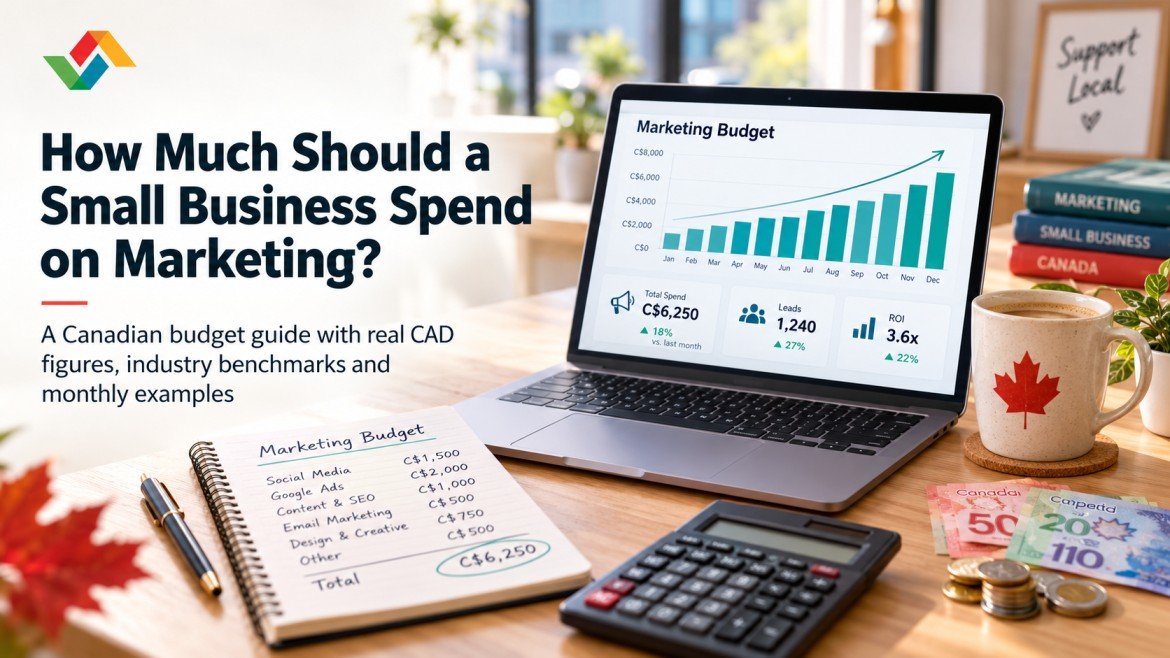
Most Canadian small businesses should spend between 2% and 10% of annual revenue on marketing. B2B companies usually land at 2% to 5%, B2C companies at 5% to 10%, and start-ups that need fast growth often invest 10% to 20%. A 2019 BDC survey of more than 1,400 Canadian businesses found that the average small business spends just over $30,000 per year, which is roughly $2,500 per month. Your own number depends on five factors: business size, industry competition, profit margins, customer acquisition cost and lifetime value, and whether you outsource.
This guide shows what $500, $1,500, $3,000 and $5,000+ monthly budgets can realistically buy in Canadian dollars. It explains how to split spending across paid advertising, SEO, content, social media, email and tools, and it lists typical budgets for retail, professional services, local businesses, B2B companies and start-ups. You will also learn how to build a budget in six steps and measure results with CAC, ROAS, ROI, cost per lead and customer lifetime value.
For owners working with limited funds, the article covers low-cost tactics and free tools that stretch a small budget further. It closes with common budgeting mistakes and answers to frequent questions, including whether to hire an agency or keep marketing in-house. Every figure is in CAD and serves as a planning guide, so test, track and adjust as your results come in.
How Much Should a Small Business Spend on Marketing?
The right amount depends on your revenue, your industry and your growth goals. A business that wants to hold its current sales needs less than one that wants to double. The subsections below answer the questions owners ask first, starting with the percentage method that most Canadian advisors recommend.
What Percentage of Revenue Should a Small Business Spend on Marketing?
The most common method is to set your budget as a percentage of gross revenue. BDC recommends 2% to 5% for B2B companies and 5% to 10% for B2C companies. Start-ups and businesses entering new markets usually spend more, because they must build awareness before sales arrive.
| Business Type | Typical Marketing Spend (% of Revenue) | Why |
|---|---|---|
| Established B2B | 2% to 5% | Fewer buyers, longer relationships, heavy reliance on referrals |
| Established B2C | 5% to 10% | More buyers, shorter sales cycles, constant need for visibility |
| Start-up or new market entry | 10% to 20% | Brand awareness must be built from zero |
| Aggressive growth phase | 12% to 20% | Market share gains need extra investment |
Keep these points in mind when applying the percentages:
- Use gross revenue as the base.
Profit swings from year to year, while revenue gives you a steadier number to plan around.
- Match the percentage to your stage.
A ten-year-old business with loyal customers needs less than a one-year-old business that must build trust from scratch.
- Treat the percentage as a starting point.
After three to six months of data, adjust it up or down based on what each channel actually returns.
- Use projected revenue for new businesses.
If you have no sales history, base the percentage on a realistic forecast and revisit it every quarter.
- Watch for the gap between recommendation and reality.
BDC’s 2019 survey showed that many small businesses spend well below the recommended percentages, which means a competitor who invests properly can win customers you never see.
How Much Should a Small Business Spend on Marketing Per Month?
Most Canadian small businesses spend between $500 and $5,000 per month. To find your number, divide your annual marketing budget by 12, then adjust for your busy and slow seasons.
- Shift spend toward your peak season.
A landscaper in Ontario should spend more from March to June, and a tax preparer should spend more from January to April.
- Add extra budget for launches.
A grand opening, new product or new location justifies a temporary spike in spending.
- Use slow months for long-term work.
Quiet periods suit SEO content, website improvements and email list building, which pay off later.
- Keep a small reserve.
Hold 5% to 10% of the monthly budget for unplanned opportunities, such as a local event sponsorship or a sudden competitor move.
How Much Should a Small Business Spend on Advertising Per Month?
Advertising is one part of marketing and usually takes 30% to 50% of the total budget. A business with a $3,000 monthly marketing budget would put $900 to $1,500 into paid ads. The rest goes to the website, content, tools and people.
- Local service businesses:
Start with $500 to $1,500 per month on Google Ads or Meta Ads, focused on a tight service area.
- Competitive industries:
Law, real estate, insurance and home renovation need more, because click costs are higher and many advertisers bid on the same keywords.
- E-commerce stores:
Often reinvest 10% to 20% of ad-driven revenue to keep campaigns growing, as long as return on ad spend stays above break-even.
- New advertisers:
Begin with a small test budget, learn which ads convert, then raise spend only on campaigns that return more than they cost.
- Seasonal advertisers:
Increase spend four to six weeks before your peak season, because ad platforms need time to learn and optimize.
What is the Average Marketing Budget by Industry?
Industry changes the answer more than almost any other factor. Retail, e-commerce and consumer services spend a larger share of revenue than manufacturing, wholesale or industrial suppliers. Industries with high customer values, such as legal, dental and financial services, also invest heavily because one new client can repay months of advertising. The full industry breakdown appears later in this article.
How Much Do Companies Spend on Advertising Per Month?
Advertising spend scales with company size and market reach.
- Small businesses: $500 to $5,000 per month.
- Mid-sized Canadian companies: Often $10,000 to $50,000 per month across several channels.
- Large national brands: Frequently several hundred thousand to millions of dollars per month, including TV, radio and out-of-home media.
Small businesses should not copy large-company budgets. Those figures reflect national reach, brand-building goals and market share that a local business does not need to chase.
How Much Does Marketing Cost Per Month for a Small Business?
If you hire help, expect these typical Canadian price ranges. Rates vary by city, experience and scope, so treat them as planning estimates.
| Service | Typical Monthly Cost (CAD) | What You Usually Get |
|---|---|---|
| Freelance marketer or social media manager | $500 to $2,500 | Content creation, posting, basic reporting |
| SEO services from an agency | $1,000 to $5,000 | Keyword research, on-page work, link building, reports |
| Paid ad management | 10% to 20% of ad spend, or $500 to $2,000 flat | Campaign setup, testing, optimization |
| Full-service agency retainer | $3,000 to $10,000+ | Strategy, creative, ads, SEO and reporting |
| Marketing software and tools | $50 to $500 | CRM, email, scheduling, analytics |
Request at least three quotes before committing, and ask each provider to show results from a similar Canadian business.
What Factors Determine a Small Business Marketing Budget?
Five factors shape most budgets. Understanding them helps you defend the number you choose and adjust it when conditions change.
Business Size and Growth Goals
Size and ambition set the baseline for your spending.
- Larger teams spend more.
BDC found that businesses with 20 to 49 employees spend about double the average small business, because they need more leads to keep staff busy.
- Growth targets raise the budget.
A business that wants 30% growth needs more marketing than one that wants to keep current customers.
- Match spend to the goal.
Define the revenue target first, then work backward to the leads and customers needed to reach it.
- Consider capacity.
There is no point generating 100 leads if your team can only serve 40. Match marketing volume to what you can deliver.
Industry and Competition
Your market decides what attention costs.
- Competition raises prices.
A plumber in Toronto pays more per click than a plumber in a smaller city, because more businesses bid on the same keywords.
- High-value industries pay more.
Legal, dental, financial and medical services have high customer values, so advertisers bid aggressively.
- Crowded markets need clear differentiation.
If many competitors offer the same service, you need a strong reason for customers to choose you, and communicating that reason costs money.
- Niche markets can be cheaper.
Specialized services often face less competition, which lowers click costs and makes SEO easier.
Profit Margins and Cash Flow
Margins decide how much you can afford, and cash flow decides how long you can wait.
- High margins allow higher spend.
A business with 60% gross margins can invest far more per sale than a grocery store or restaurant with 5% to 10% margins.
- Most channels need time.
SEO, content and brand building often need three to six months to show results, so never commit to spending you cannot sustain.
- Seasonal cash flow matters.
Plan to spend most when cash is strongest, but keep a reserve for slow periods.
- Calculate break-even.
Know how much profit each sale earns, so you know the maximum you can pay to win it.
Customer Acquisition Cost and Lifetime Value
These two numbers tell you whether your spending makes sense.
- Customer acquisition cost (CAC) is what you pay to win one customer. Add all marketing and sales costs, then divide by the number of new customers.
- Customer lifetime value (LTV) is what that customer brings in over the relationship, including repeat purchases and referrals.
- The ratio guides your budget. An LTV to CAC ratio of 3 to 1 or better usually signals healthy spending. If a customer is worth $2,000 over three years, paying $300 to acquire them is a strong investment.
- High LTV justifies higher spending. Subscription businesses, clinics and service contractors can outspend competitors because each customer stays longer.
In-House Marketing vs. Outsourcing
Each model has clear trade-offs.
- In-house gives you control.
A full-time marketing coordinator commonly costs $50,000 to $75,000 per year in Canada before benefits, and knows your business deeply.
- Outsourcing gives you specialists.
A monthly fee can buy SEO, design, copywriting and ad management without hiring several people.
- Agencies bring tools and experience.
They have worked across many accounts, so they often spot problems faster.
- A hybrid model often works best.
Keep brand voice and customer communication in-house, then outsource technical work like SEO and paid ads.

Free download
Find out what's stopping local customers from finding you on Google
The Ontario Local SEO Checklist
- 32 practical checks across your Google Business Profile, reviews, listings, website, tracking and AI answers
- A simple scoring guide that shows where you stand and what to fix first
- Plain-English steps you can do yourself, most in under an hour
PDF · 5 pages · printable
Small Business Marketing Budget Examples
These examples show what each monthly level can realistically cover in Canada. Use them to see where your own budget fits and what you can reasonably expect.
$500 per Month Marketing Budget
This level suits sole proprietors, home-based businesses and early-stage shops. Your own time does most of the work, so focus on low-cost, high-trust channels.
| Item | Monthly Cost |
|---|---|
| Google Business Profile and reviews | $0 |
| Website hosting, domain and basic tools | $50 to $100 |
| Email marketing platform | $20 to $50 |
| Local ads or small Meta Ads test | $200 to $300 |
| Design and content tools | $30 to $50 |
- Google Business Profile ($0): A complete profile with photos, hours and fresh reviews drives local calls, visits and direction requests for free.
- Website and hosting ($50 to $100): Keep your site fast, secure and mobile-friendly, since most local searches happen on phones.
- Email platform ($20 to $50): Build a list from day one, because email reaches people who already know you.
- Local ads ($200 to $300): Target a tight radius around your location and track every enquiry to see what works.
- Design tools ($30 to $50): Tools like Canva help you create consistent posts, flyers and ads without hiring a designer.
Expected outcome: A steady trickle of local leads and better online visibility. Growth will be slow, but the foundation is solid.
$1,500 per Month Marketing Budget
This level fits small local businesses with steady customers. It allows a healthy mix of paid and organic work.
| Item | Monthly Cost |
|---|---|
| Google Ads or Meta Ads | $600 to $800 |
| Freelance content or social media help | $400 to $500 |
| Email marketing and automation | $50 to $100 |
| SEO tools and analytics | $100 to $150 |
| Photography or video refresh | $100 to $150 |
- Paid ads ($600 to $800): Run one or two focused campaigns aimed at your most profitable service.
- Freelance help ($400 to $500): A part-time freelancer keeps your channels active and your content consistent.
- Email automation ($50 to $100): Set up welcome emails, review requests and win-back sequences that run on their own.
- SEO tools ($100 to $150): Track rankings, traffic and conversions so you can see which pages bring in business.
- Visual content ($100 to $150): Fresh photos and short videos improve ad performance and website trust.
Expected outcome: Consistent lead flow, a more professional brand presence and enough data to start making smart decisions.
$3,000 per Month Marketing Budget
This level suits growing businesses that want measurable lead generation. It often covers a part-time specialist or a small agency package.
| Item | Monthly Cost |
|---|---|
| Paid advertising | $1,200 to $1,500 |
| SEO and content marketing | $800 to $1,000 |
| Social media management | $400 to $500 |
| Email, CRM and analytics tools | $200 to $300 |
- Paid advertising ($1,200 to $1,500): Split spend between search ads and social ads, and test new audiences and offers every month.
- SEO and content ($800 to $1,000): Publish service pages, blog posts and local landing pages that attract organic traffic over time.
- Social media ($400 to $500): Maintain a regular posting schedule with community engagement and occasional promoted posts.
- Tools ($200 to $300): Connect leads to sales in a CRM so you can measure return on every channel.
Expected outcome: Several active channels, clearer reporting and the ability to test what produces the lowest cost per customer.
$5,000+ per Month Marketing Budget
This level supports aggressive growth, multi-location businesses and competitive industries. At this stage, tracking and strategy matter as much as spending.
| Item | Monthly Cost |
|---|---|
| Agency retainer or in-house marketer | $2,000 to $3,500 |
| Multi-channel paid advertising | $1,500 to $3,000 |
| SEO and content production | $800 to $1,500 |
| Conversion rate optimization | $300 to $800 |
| Analytics, CRM and automation | $300 to $600 |
- Agency or in-house marketer: One accountable team or person manages strategy, execution and reporting.
- Multi-channel advertising: Run search, social, display and video campaigns together to reach customers at different stages.
- SEO and content: Build topical authority with consistent, high-quality publishing aimed at your most valuable keywords.
- Conversion rate optimization: Test landing pages, forms and offers to turn more visitors into customers without raising ad spend.
- Advanced analytics: Track every lead from first click to closed sale, and automate follow-up so no enquiry is lost.
Expected outcome: Strong market presence, predictable lead flow and the data needed to scale profitably.
How Should a Small Business Allocate Its Marketing Budget?
A balanced starting split looks like the table below. Adjust it based on what produces leads for you, and review the split every quarter.
| Category | Suggested Share of Budget |
|---|---|
| Paid advertising | 30% to 40% |
| Website and SEO | 20% to 25% |
| Content marketing | 15% to 20% |
| Social media | 10% |
| Email and retention | 5% to 10% |
| Tools and analytics | 5% to 10% |
Paid Advertising
Paid advertising delivers the fastest results, and it stops the moment you stop paying.
- Google Ads captures active demand.
People searching for “emergency plumber” or “dentist near me” are ready to buy, so these clicks convert well.
- Meta Ads create demand.
Facebook and Instagram let you reach defined audiences by location, age and interests, which suits retail, restaurants and events.
- LinkedIn Ads suits B2B.
Costs per click are higher, but you can target job titles and industries directly.
- Click costs vary widely.
Local service keywords in Canada commonly cost $2 to $10 per click, while legal and financial keywords can cost far more.
- Set a monthly cap and review weekly.
Pause underperforming ads quickly and move the budget to winners.
Website Development and SEO
Your website is your most important marketing asset, because every channel eventually sends people to it.
- Website build costs: A small business site typically costs $2,000 to $10,000, depending on size, design and features.
- SEO costs: Ongoing SEO usually runs $1,000 to $3,000 per month for a small business.
- SEO takes time. Expect three to six months before traffic grows noticeably, but the results keep paying off without a cost per click.
- Local SEO is the quickest win. Optimize your Google Business Profile, collect reviews and keep your name, address and phone number consistent across directories.
- Technical basics matter. Fast load times, mobile design and clear calls to action raise conversions from every channel.
Content Marketing
Content builds trust and feeds both SEO and social media.
- Blog posts and guides answer the questions customers search before buying, and they bring in organic traffic for years.
- Case studies show real results and reduce buyer doubt, which helps in high-trust industries.
- Video explains services quickly and performs well on social platforms and in search.
- Repurposing stretches your budget. Turn one article into an email, three social posts and a short video.
- Quality beats volume. One strong guide that ranks well is worth more than ten thin posts.
Social Media Marketing
Social media builds awareness, community and brand personality.
- Choose platforms by customer behaviour.
Visual products suit Instagram and Pinterest, while professional services suit LinkedIn.
- Do fewer platforms well.
Two active channels beat five neglected ones.
- Budget for creation and promotion.
Cover content production, scheduling tools and a small amount of paid boosting.
- Respond to messages and comments.
Fast replies build trust and turn followers into customers.
- Treat social media as a support channel.
For many small businesses, it works best alongside search and email instead of replacing them.
Email Marketing and Customer Retention
Email delivers one of the strongest returns in marketing because it reaches people who already know you.
- Follow CASL rules.
Canada’s Anti-Spam Legislation requires consent before you send commercial emails, so use opt-in forms and keep consent records.
- Automate key emails.
Welcome series, abandoned cart reminders, review requests and win-back campaigns run without daily effort.
- Segment your list.
Sending different messages to new customers, repeat buyers and inactive contacts lifts open and click rates.
- Invest in retention.
Keeping a customer costs far less than acquiring a new one, so loyalty offers and follow-up are worth the real budget.
Marketing Tools and Analytics
Tools show you what is working and save you time.
- Free essentials: Google Analytics and Google Search Console cost nothing and cover most small business needs.
- Paid tools: A CRM, email platform, call tracking and design software usually add $50 to $500 per month.
- Tracking is non-negotiable. Without analytics, you cannot tell which dollars bring in customers.
- Keep your stack simple. Every extra tool adds cost and complexity, so only add one when it solves a clear problem.
Average Marketing Budget by Industry
Treat these as planning ranges. Your own margins, goals and competition matter more than any industry average.
| Industry | Typical Spend (% of Revenue) | Main Channels |
|---|---|---|
| Retail and e-commerce | 5% to 15% | Paid search, social ads, email |
| Professional services | 5% to 10% | Referrals, local SEO, LinkedIn |
| Local businesses | 5% to 10% | Google Business Profile, local ads, reviews |
| B2B companies | 2% to 5% | Content, email, LinkedIn, events |
| Start-ups | 10% to 20% | Paid ads, social, PR, partnerships |
Retail and E-commerce Marketing Budgets
Retail and online stores compete on visibility and price, so they spend a larger share of revenue.
- Typical range: 5% to 15% of revenue.
- Main channels: Paid search, shopping ads, social ads, email and influencer partnerships.
- Seasonal peaks: Black Friday, Boxing Day, the holidays and back-to-school need larger budgets and early planning.
- Key metric: Return on ad spend, since thin margins leave little room for waste.
- Retention matters: Email and loyalty programs lift repeat purchases and lower the cost of each sale.
Professional Services Marketing Budgets
Clients in this group buy on credibility, so trust-building drives the budget.
- Typical range: 5% to 10% of revenue.
- Who this covers: Law firms, accountants, consultants, financial advisors and agencies.
- Main channels: Referrals, local SEO, LinkedIn, speaking events and educational content.
- Trust matters most. Reviews, testimonials and case studies carry extra weight when clients buy based on expertise.
- Long sales cycles: Expect leads to take weeks or months to convert, so nurture them with email and useful content.
Local Business Marketing Budgets
Local businesses win by being the obvious choice in their neighbourhood.
- Typical range: 5% to 10% of revenue.
- Who this covers: Restaurants, clinics, salons, contractors, fitness studios and retail shops.
- Local search leads the way. A complete Google Business Profile with strong reviews often brings in more customers than any single ad.
- Offline channels still work. Flyers, community sponsorships, local newspapers and Canada Post neighbourhood mail can reach customers online ads miss.
- Many businesses underspend. BDC’s 2019 survey found that businesses with revenue under $2 million spent around $30,000 per year, which is only about 1.5% of revenue at the higher end of that group.
B2B Marketing Spend as a Percentage of Revenue
B2B companies spend less as a share of revenue, but each lead is worth more.
- Typical range: 2% to 5% of revenue, with technology and software firms going higher.
- Sales cycles are longer. Buyers research for weeks or months, so content, email nurturing and LinkedIn matter.
- Lower spend than B2C. B2B companies often spend about half as much as consumer-facing businesses.
- Events and partnerships help. Trade shows, webinars and referral partnerships often produce high-value leads.
- Sales and marketing must work together. Shared lead definitions and fast follow-up raise the return on every dollar.
Startup Marketing Budgets
Start-ups must build awareness and trust at the same time.
- Typical range: 10% to 20% of projected revenue, sometimes more during a launch.
- Awareness must be built from zero. Early spending goes toward getting known.
- Test before scaling. Try one or two channels, find the lowest cost per customer and double down.
- Watch the cash runway. Marketing should not drain the money needed to operate.
- Use founder-led marketing. Personal LinkedIn posts, community involvement and partnerships cost little and build credibility early.
How to Create a Marketing Budget for a Small Business
Building a budget takes six steps. Repeat the process each year, and revisit it every quarter.
Set Marketing Goals and Revenue Targets
Clear goals turn a vague budget into a plan.
- Start with a revenue number. “Grow revenue from $400,000 to $500,000 this year” gives you a target to work backward from.
- Convert revenue into customers. Divide the target by your average sale value to find how many new customers you need.
- Convert customers into leads. Use your close rate to estimate how many leads you must generate.
- Set specific marketing goals. Examples include 40 new leads per month, a 15% rise in website traffic or 25 new Google reviews per quarter.
Calculate Your Available Marketing Budget
Turn your goals into a dollar figure you can afford.
- Apply your percentage. A B2C business with $400,000 in revenue using 7% sets aside $28,000 per year, or about $2,333 per month.
- Check against cash flow. Confirm you can sustain the spend even if sales dip.
- Include all costs. Count tools, design, staff time and agency fees, not only ad spend.
- Cross-check with goals. If the budget cannot realistically produce the leads you need, either raise it or lower the target.
Choose the Right Marketing Channels
Channel choice should follow customer behaviour, not trends.
- Follow customer behaviour. Urgent services respond to Google Ads and local SEO, while visual products respond to Instagram.
- Consider sales cycle length. Long cycles favour content and email, while impulse buys favour social and paid ads.
- Pick two or three channels. Doing a few well beats spreading thin.
- Check where competitors are weak. A channel your rivals ignore can offer cheaper customers.
Create a Monthly Marketing Budget Sample
A written sample keeps spending organized. Here is a $2,500 monthly budget:
| Category | Monthly Amount | Share |
|---|---|---|
| Paid advertising | $900 | 36% |
| SEO and website upkeep | $600 | 24% |
| Content creation | $400 | 16% |
| Social media | $250 | 10% |
| Email and CRM tools | $150 | 6% |
| Analytics and testing | $200 | 8% |
| Total | $2,500 | 100% |
Build your own version in a spreadsheet with three columns for each category: planned, actual and result.
Track Marketing Costs and Performance
Tracking makes the budget accountable.
- Record every expense by channel and month so nothing hides in general overhead.
- Tie spend to results using Google Analytics, UTM links, call tracking and your CRM.
- Ask customers how they found you. Compare their answers with your data to catch what tracking misses.
- Build a simple dashboard. Include spend, leads, cost per lead, customers and revenue by channel.
Adjust Your Budget Based on Results
A budget is a living document.
- Review monthly and reset quarterly. BDC advises assessing your budget quarterly and annually to confirm it matches actual spending.
- Move money to winners. Shift budget from weak channels to strong ones.
- Cut after a fair trial. Drop any channel that has not produced results after three months of consistent effort.
- Scale gradually. Raise spending on a winning channel by 10% to 20% at a time, so you can see whether returns hold.
Want this checked on your own site? Get my free SEO audit
How to Measure Marketing ROI and Budget Performance
Five metrics show whether your budget is working. Track them monthly and compare them across channels.
| Metric | What It Tells You |
|---|---|
| CAC | What you pay to win a customer |
| ROAS | Revenue earned per ad dollar |
| Marketing ROI | Overall profit from marketing |
| Cost per lead and conversion rate | Efficiency of lead generation and sales |
| LTV | Long-term value of each customer |
Customer Acquisition Cost (CAC)
CAC shows how much it costs to win one customer.
- Formula: Total marketing and sales spend divided by new customers won.
- Example: Spending $3,000 to win 20 customers gives a CAC of $150.
- How to use it: Compare CAC against customer lifetime value and gross margin to confirm each customer is profitable.
- Track it by channel. A blended CAC can hide the fact that one channel is expensive and another is cheap.
Return on Ad Spend (ROAS)
ROAS measures how much revenue each advertising dollar generates.
- Formula: Revenue from ads divided by ad spend.
- Example: $1,000 in ads that brings in $4,000 in sales gives a ROAS of 4.
- How to use it: Calculate your break-even ROAS from your margins before you scale campaigns. A business with 50% margins needs a ROAS of at least 2 to break even.
- Limit: ROAS ignores non-ad costs, so pair it with ROI for the full picture.
Marketing Return on Investment (ROI)
Marketing ROI shows the profit your total marketing effort produces.
- Formula: (Revenue from marketing minus marketing cost) divided by marketing cost.
- Example: $5,000 in marketing that produces $20,000 in gross profit delivers a 300% ROI.
- How to use it: Use ROI to compare channels and decide where the next dollar should go.
- Allow for delay. SEO and content take months to pay off, so judge them over a longer window than paid ads.
Cost per Lead and Conversion Rate
These two numbers show how efficiently you turn spend into sales.
- Cost per lead shows what you pay for each enquiry.
- Conversion rate shows what share of leads become customers.
- Example: A $40 cost per lead with a 25% close rate gives a CAC of $160.
- How to use them: Improving either number lowers your acquisition cost without raising spend. Faster follow-up and better landing pages often help most.
Customer Lifetime Value (LTV)
LTV shows what a customer is worth over the whole relationship.
- Formula: Average revenue per customer multiplied by average time they stay with you.
- Why it matters: A strong LTV lets you spend more to acquire customers and still stay profitable.
- Retention connection: Raising repeat purchase rates lifts LTV, which is why retention work pays for itself.
- Target ratio: Aim for an LTV to CAC ratio of at least 3 to 1.
How Can a Small Business Market Itself on a Limited Budget?
A small budget works well when it is focused and consistent. Time and creativity can replace money in many channels.
Low-Cost Marketing Strategies
These tactics cost little but can bring in real customers.
- Claim your Google Business Profile. It costs nothing and drives local calls, visits and directions.
- Ask every happy customer for a review. Reviews lift local rankings and persuade new buyers. Send a direct link by text or email right after a sale.
- Build an email list. Offer a discount or useful guide in exchange for sign-ups, then send a useful message once or twice a month.
- Partner with nearby businesses. Cross-promotions put you in front of customers who already trust a neighbour.
- Join your local Chamber of Commerce or Board of Trade. Membership brings networking, referrals and local visibility.
- Share useful content. Posts that answer common questions build authority on LinkedIn, Facebook and Instagram.
- Run a referral program. A small reward for each referral often beats paid advertising on cost per customer.
- Host or sponsor a local event. A workshop, charity drive or community booth builds goodwill and local press.
Free Marketing Tools for Small Businesses
| Tool | Best Use |
|---|---|
| Google Business Profile | Local search visibility |
| Google Analytics and Search Console | Traffic tracking and SEO insights |
| Canva | Social posts, flyers and simple video |
| Mailchimp or MailerLite free plans | Email campaigns for small lists |
| Meta Business Suite | Scheduling Facebook and Instagram posts |
| Google Looker Studio | Free reporting dashboards |
Free plans have limits, so upgrade only when you hit a real ceiling.
How to Reduce Marketing Costs Without Sacrificing Results
Cutting waste often improves results more than adding spend.
- Pause what is not working. Cut channels that have not produced a customer in three months.
- Repurpose content. Turn one article into an email, social posts and a short video.
- Negotiate software pricing. Annual plans often cost less than monthly billing.
- Split work smartly. Handle simple tasks like scheduling in-house and outsource only skilled work.
- Improve conversion first. Raising your website conversion rate from 2% to 3% brings in 50% more leads from the same traffic.
- Check the tax treatment. Advertising is generally a deductible business expense in Canada, and registered businesses can often claim GST/HST input tax credits on marketing purchases. Confirm details with your accountant.
Common Small Business Marketing Budget Mistakes
Spending Without Clear Marketing Goals
- The problem: Without a target, you cannot judge success or failure, and money drifts toward whatever feels busy.
- The fix: Define what a good month looks like in leads, calls or sales before you launch anything.
- Example: “Generate 30 qualified leads at under $50 each” is a goal you can measure and improve.
Copying Competitors’ Marketing Budgets
- The problem: You cannot see a rival’s margins, costs or results. Their high spend may be losing money.
- The fix: Build your budget from your own revenue, margins and customer value.
- Better use of competitors: Study their offers, messaging and channels for ideas, not their spending.
Confusing Advertising Costs With Total Marketing Costs
- The problem: Advertising is one line item. Website, content, tools, design, staff time and agency fees also count.
- The fix: Track all marketing costs together so your CAC reflects the real number.
- Result: An honest cost picture prevents you from scaling a channel that only looks profitable.
Failing to Track Marketing ROI
- The problem: Without tracking, you cannot cut what is failing or fund what is working.
- The fix: Set up analytics, call tracking and CRM reporting before you spend your first dollar.
- Habit to build: Review a one-page report every month, and make one decision from it.
Quitting Too Soon or Changing Too Often
- The problem: SEO, content and brand building need months to work, and constant strategy changes reset progress.
- The fix: Give each channel at least three months of consistent effort before judging it, unless the numbers are clearly poor.
FAQs
Is 5% of Revenue Enough for a Small Business Marketing Budget?
For most established B2B businesses, yes. For B2C businesses, 5% sits at the low end of the recommended 5% to 10% range. It can work if you already have strong word of mouth and repeat customers. It is usually too low for a business that wants fast growth or operates in a competitive market.
Is 10% of Revenue Too Much to Spend on Marketing?
Not for a B2C business, a start-up or a business in a growth phase. For a mature B2B company with a stable customer base, 10% may be more than needed. The deciding factor is return. If each dollar brings back more profit than it costs, the spend is justified.
How Much Should a Startup Spend on Marketing?
Most start-ups should plan for 10% to 20% of projected revenue, or $1,000 to $3,000 per month in the early stages. Test one or two channels, measure cost per customer and then scale what works. Keep enough cash in reserve to cover operating costs while marketing builds momentum.
How Much Should a Small Business Spend on Advertising Per Month?
Most small businesses spend $500 to $3,000 per month on advertising, which is about 30% to 50% of the total marketing budget. Local service businesses can start at the lower end and increase once they see a positive return. Competitive industries need more.
What Is the Average Marketing Budget for a Small Business?
In Canada, BDC’s 2019 survey found the average is just over $30,000 per year, or roughly $2,500 per month. Averages hide wide variation, so use your own revenue, industry and goals to set a final figure.
How Much Do Companies Spend on Advertising Per Month?
Small businesses typically spend $500 to $5,000 per month. Mid-sized companies often spend $10,000 to $50,000. Large brands spend far more. Spending tracks company size, market reach and growth goals.
What Is a Marketing Budget Sample?
A marketing budget sample is a template that lists expected marketing costs by category, month and channel. It compares planned spend against actual spend so you can review performance. The $2,500 monthly table earlier in this article is one example. A good sample includes columns for planned spend, actual spend, leads generated and cost per lead.
Where Can I Find a Marketing Budget Sample PDF?
BDC publishes marketing planning guides and tools on its website, and many Canadian banks and business associations offer free templates. You can also build your own in Excel or Google Sheets and export it as a PDF. Search for “marketing budget template” and choose one that lets you track planned spend, actual spend and results by channel.
How Much Should a B2B Business Spend on Marketing as a Percentage of Revenue?
Most B2B businesses should spend 2% to 5% of revenue, based on BDC guidance. Technology, software and professional services firms often go higher, because their sales cycles are longer and customer values are larger. Companies entering a new market or launching a new product may temporarily spend more.
Should a Small Business Hire a Marketing Agency or Handle Marketing In-House?
The answer depends on budget, skills and time. - Choose in-house when your budget is under about $1,500 per month and you have time to learn. You keep control and save on fees. - Choose an agency when you need several skills at once, such as SEO, paid ads and content, and your budget is $3,000 or more per month. - Choose a hybrid model if you want control of brand and customer communication while outsourcing technical work like SEO and ad management. - Vet any agency carefully. Ask for Canadian case studies, clear reporting, month-to-month terms and a named contact who will manage your account.
Want this checked on your own site? Get my free SEO audit
Free download
Find out what's stopping local customers from finding you on Google
The Ontario Local SEO Checklist
- 32 practical checks across your Google Business Profile, reviews, listings, website, tracking and AI answers
- A simple scoring guide that shows where you stand and what to fix first
- Plain-English steps you can do yourself, most in under an hour
PDF · 5 pages · printable

Written by
Shubhan SopariwalaSr. SEO Strategist, VASP Digital · London, Ontario
A SEO strategist with deep expertise in technical and semantic SEO, Shubhan combines data science principles with content marketing strategies to deliver comprehensive search optimization strategies.