On this page
- Key takeaways
- What is AI Marketing?
- Why Does AI Matters for Small Business Marketing?
- Save Time on Repetitive Tasks
- Do More With a Small Marketing Team
- Better Understand Customers
- Improve Personalization
- Make Marketing Decisions Faster
- How Small Businesses Can Use AI in Marketing?
- Content Creation
- SEO
- Email Marketing
- Social Media Marketing
- Paid Advertising
- Customer Service and Lead Generation
- The Best Types of AI Tools for Small Businesses
- What AI Can’t Replace in Small Business Marketing?
- Risks and Challenges of Using AI for Marketing
- Inaccurate Information
- Generic Content
- Privacy Concerns
- Brand Voice
- Over-Automation
- Copyright and Originality
- How to Get Started With AI Marketing?
- Identify One Repetitive Marketing Task
- Choose an Appropriate AI Tool
- Create Clear Instructions and Brand Guidelines
- Keep a Human Review Step
- Measure the Results
- Expand Gradually
- AI Marketing Best Practices for Small Businesses
- FAQs
AI for small business marketing means using machine learning and generative AI to create content, analyze customer data, automate campaigns, and personalize outreach with fewer hours and lower costs. It matters because small businesses face tight budgets, limited staff, and strong competition, and AI gives them access to capabilities that once required a full marketing department. It saves time on repetitive tasks, helps small teams produce more, reveals customer patterns, improves personalization, and speeds up decisions.
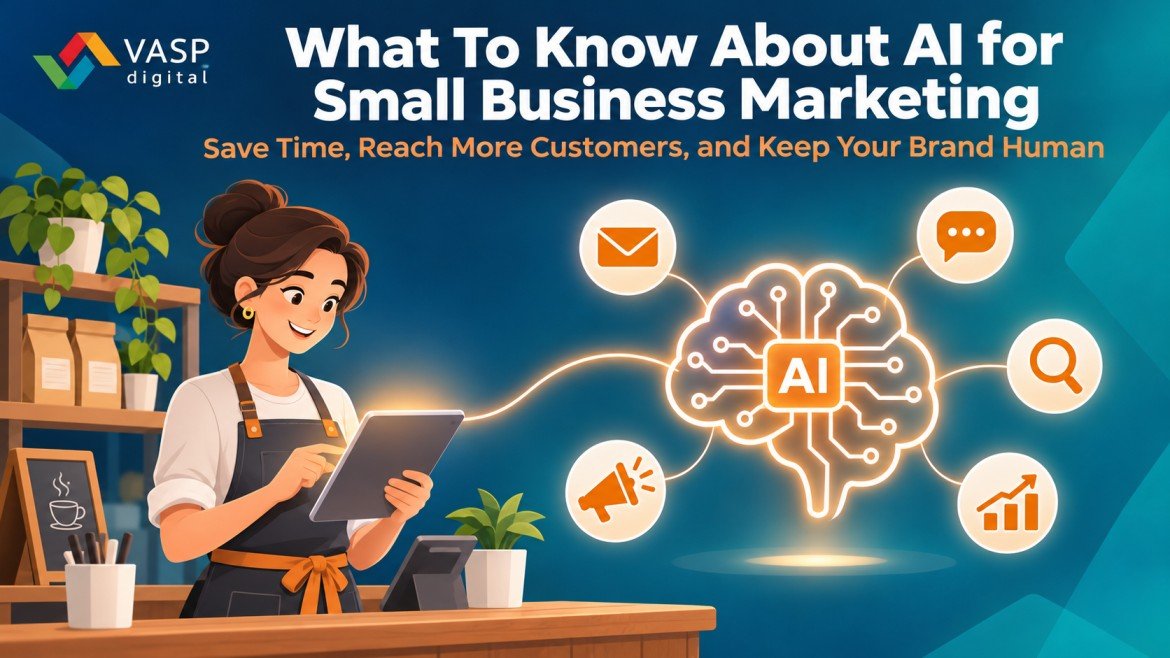
Small businesses can apply AI across content creation, SEO, email marketing, social media, paid advertising, customer service, and lead generation. Tool categories include writing assistants, design and video generators, SEO platforms, automation software, chatbots, analytics dashboards, and AI-powered CRMs.
AI cannot replace strategy, empathy, brand values, or authentic relationships. It also carries risks such as inaccurate information, generic content, privacy concerns, inconsistent brand voice, over-automation, and unclear copyright rules.
The safest way to begin is to pick one repetitive task, choose a fitting tool, write clear brand guidelines, review every output, measure results, and expand gradually. This guide covers each step, along with best practices and answers to common questions, so you can use AI to compete confidently while keeping your marketing human.
What is AI Marketing?
AI marketing is the practice of using artificial intelligence technologies to plan, create, deliver, and measure marketing activity. These technologies include machine learning, natural language processing, computer vision, and generative AI. Each one handles a different job, so understanding the difference helps you choose the right tool.
- Generative AI creates new text, images, audio, and video from a written prompt. ChatGPT, Claude, Gemini, and Canva’s AI features are common examples.
- Predictive AI analyzes past data to forecast future behavior, such as which leads will buy, which subscribers will unsubscribe, or which products will sell next month.
- Natural language processing reads and interprets human language, which powers chatbots, sentiment analysis, and review summaries.
- Automation with AI triggers actions based on customer behavior, such as sending a discount code after an abandoned cart.
Most small businesses already use AI marketing without labeling it that way. Mailchimp suggests send times, Google Ads adjusts bids automatically, Meta Ads finds lookalike audiences, and Shopify recommends products. AI marketing therefore does not require a new technology stack. It often starts with features that already sit inside your current tools.
The key difference from traditional marketing automation is learning. Basic automation follows fixed rules written by a person. AI systems improve their output as they process more data.
Why Does AI Matters for Small Business Marketing?
AI matters for small business marketing because it reduces the cost and time barrier between a small company and a professional marketing operation. A bakery, a plumbing company, a boutique agency, and an online store can now produce content, run segmented email campaigns, and analyze performance at a level that once required a dedicated department.
The impact is practical. Small businesses face tight budgets, limited staff, and constant competition for local and online attention. AI addresses each of these pressures directly, as the five benefits below show.
Save Time on Repetitive Tasks
AI saves time by taking over the repetitive work that fills a marketer’s week. Writing first drafts, resizing images for different platforms, scheduling posts, tagging leads, transcribing calls, and summarizing analytics reports all fit this category.
Consider a business owner who spends five hours a week on social captions and email drafts. With AI generating first versions, that same work may take one or two hours, leaving the rest for customer calls, partnerships, and product improvement. The saved hours are the most immediate return on investment, and they are easy to measure.
Do More With a Small Marketing Team
AI lets a small team produce the output of a larger one. A single marketer can turn one customer interview into a blog post, five social posts, an email newsletter, and a short video script within an afternoon. This repurposing process keeps publishing frequency consistent, which supports both audience growth and search visibility.
AI also covers skill gaps. A founder with no design background can create decent graphics, and a designer with no copywriting experience can draft ad headlines. The team gains range without hiring a specialist for every channel.
Better Understand Customers
AI improves customer understanding by finding patterns in data that humans rarely have time to review. It can read hundreds of customer reviews and group them by theme, such as delivery speed, pricing, or product quality. It can analyze website behavior to show which pages lead to purchases and which pages cause visitors to leave.
These insights answer practical questions. What do customers ask before buying? Which products are purchased together? Which message type drives clicks? When you know the answers, you can write a copy that mirrors real customer language, which increases relevance and conversion.
Improve Personalization
AI personalizes marketing by adjusting messages, offers, and timing to each customer’s behavior and preferences. A returning shopper sees recommendations based on past purchases. A new subscriber receives a welcome series built around the signup source. A lapsed customer gets a win-back offer at the moment their usual buying pattern suggests they are drifting away.
Personalization raises engagement because it makes a message feel relevant rather than mass-produced. Relevant emails earn more opens and clicks, and relevant ads waste less budget on the wrong audience.
Make Marketing Decisions Faster
AI shortens the gap between data and decisions. Instead of exporting spreadsheets and building charts, you can ask an AI assistant to summarize last month’s campaign results, identify the weakest ad group, or explain why email revenue dropped. Many analytics tools now provide plain-language insights and anomaly alerts.
Faster decisions matter because marketing opportunities expire quickly. A trending topic, a seasonal demand spike, or an underperforming ad can cost money within days if nobody notices.

Free download
When customers ask AI for a recommendation, does your business come up?
How to Get Your Business Recommended by ChatGPT and Google AI
- A 10-minute self-test to see what ChatGPT, Gemini, Perplexity and Google AI Overviews say about you
- 10 practical actions that make your business easier for AI tools to find, understand and trust
- A one-page action plan for your first week, first month and beyond
PDF · 7 pages · printable
How Small Businesses Can Use AI in Marketing?
AI fits into every major marketing channel. The most effective approach is to match each channel with a specific job rather than using AI everywhere at once.
Content Creation
AI content creation covers blog posts, product descriptions, newsletters, video scripts, social captions, and visual assets. Generative writing tools produce drafts from a short brief that includes your audience, goal, tone, and key points. Image tools create social graphics, ad backgrounds, and product mockups. Video tools generate short clips, captions, and voiceovers.
Quality depends on input. A vague prompt such as “write a blog about coffee” produces vague content. A detailed prompt that names the audience, location, product, and desired action produces a far more useful draft. Practical uses include:
- Turning bullet notes into a full article draft
- Rewriting product descriptions for different audiences
- Creating ten headline options for testing
- Converting a webinar transcript into several short posts
The best workflow treats AI as a drafting partner. Add real customer stories, local details, original opinions, and brand personality before publishing. That human layer separates helpful content from generic filler.
SEO
AI supports search engine optimization by speeding up research, content planning, and on-page improvements. It can cluster keywords by search intent, suggest related questions people ask, analyze top-ranking competitor pages, and recommend headings, internal links, and schema markup. It can also write title tags and meta descriptions at scale.
Local SEO benefits strongly. AI can draft Google Business Profile updates, respond to customer reviews, and create service-area page outlines that mention nearby neighborhoods and common local questions.
Search engines such as Google reward content that is helpful, accurate, and written with real experience, so AI should support the research and structure. Publishing large volumes of thin, unedited AI pages risks low rankings and lost trust. Strong AI-assisted SEO combines machine speed with human expertise, original examples, and fact-checking.
Email Marketing
AI improves email marketing at every stage, from writing to analysis. It generates subject lines and preview text, tests variations, predicts the best send time for each subscriber, and segments lists by behavior. It also powers dynamic content blocks that change based on the reader’s interests.
High-value automated flows include:
- Welcome series that introduces your brand and first offer
- Abandoned cart reminders that recover lost sales
- Post-purchase follow-ups that request reviews and suggest related products
- Win-back campaigns that re-engage inactive customers
These flows run continuously after setup, which creates steady revenue with little ongoing effort. Review performance monthly, because open rates, click rates, and unsubscribe rates show whether the AI-assisted messages still match audience expectations.
Social Media Marketing
AI helps social media marketing by planning, creating, scheduling, and analyzing content. It can build a monthly content calendar, suggest post ideas based on trending topics, rewrite captions for different platforms, and turn one long video into several clips. Scheduling tools recommend posting times based on audience activity.
Social listening is another strong use. AI monitors brand mentions, competitor activity, and sentiment, so you can respond quickly to praise, questions, and complaints. Speed and tone both matter on social platforms, and a prompt reply often turns a dissatisfied customer into a loyal one.
Authenticity still drives engagement. Real photos, short behind-the-scenes videos, and genuine replies usually outperform polished but impersonal AI content.
Paid Advertising
AI strengthens paid advertising by testing creative, managing bids, refining audiences, and moving budget toward high performers. Google Ads and Meta Ads already rely on machine learning to optimize delivery, which means the quality of your inputs shapes the results. Those inputs include accurate conversion tracking, clear audience signals, strong creative assets, and well-written ad copy.
Small businesses can use AI to generate multiple headlines and descriptions, build responsive search ads, and analyze which creative variations produce the lowest cost per lead. Set clear budgets and review the reports regularly. Automated campaigns can spend money quickly in the wrong direction when tracking is broken or goals are unclear.
Customer Service and Lead Generation
AI chatbots and virtual assistants answer common questions, collect contact details, qualify leads, and book appointments at any hour. A visitor who asks about pricing at 11 p.m. can receive an immediate answer instead of waiting until morning, which improves both satisfaction and conversion.
Lead scoring tools rank prospects based on behavior, such as page visits, email clicks, and form submissions. A small sales team can then contact the warmest leads first. AI call transcription and CRM tools also log conversations and suggest follow-up steps.
Keep a clear path to a real person. Complex requests, complaints, and high-value sales conversations need human empathy and judgment.
The Best Types of AI Tools for Small Businesses
The best AI tools for small businesses fit a specific job, work with your existing software, and have clear privacy terms. Thinking in categories is more useful than chasing brand names, because tools change quickly.
| Tool category | Main job | Best for |
|---|---|---|
| Generative writing assistants | Draft blogs, emails, ads, and captions | Content creation and brainstorming |
| AI design and video tools | Create graphics, mockups, and short videos | Social media and ad creative |
| SEO and content optimization tools | Recommend keywords, headings, and content gaps | Organic search growth |
| Email and marketing automation platforms | Segment lists and trigger campaigns | Retention and repeat sales |
| Social media management tools | Schedule posts and report performance | Consistent publishing |
| AI chatbots and virtual assistants | Answer questions and qualify leads | Customer support and lead capture |
| Analytics and reporting tools | Summarize data and flag trends | Faster decisions |
| CRM platforms with built-in AI | Score leads and suggest next steps | Sales follow-up |
Before choosing, compare five factors: ease of use, price, integrations, data privacy, and quality of customer support. Many small businesses get the most value from AI features already included in tools they pay for, such as their email platform or CRM. This approach avoids extra subscriptions and reduces the learning curve.
What AI Can’t Replace in Small Business Marketing?
AI cannot replace human judgment, empathy, original creativity, or personal relationships. It generates content from patterns in existing data, which means it does not know your customers by name, understand your local community, or experience the story behind your business.
Several marketing functions depend on people:
- Strategy: Owners decide who to serve, how to position the brand, and which opportunities to pursue.
- Brand values and ethics: Humans decide what the business stands for and what it will never say.
- Relationships: Customers return because of trust, and trust grows through real conversations, reliable service, and consistent follow-through.
- Authentic proof: Real testimonials, original photos, case studies, and community involvement carry credibility that synthetic content cannot match.
- Emotional intelligence: People notice tone, handle sensitive situations, and respond to unspoken concerns.
A useful rule is that AI handles production and people handle meaning. The strongest small business marketing combines machine efficiency with human character.
Risks and Challenges of Using AI for Marketing
AI marketing carries real risks, but most are manageable with clear processes. Understanding each one helps you adopt AI with confidence rather than fear.
Inaccurate Information
AI tools can produce false statements that sound confident. They may invent statistics, misquote sources, or describe products and services incorrectly. This problem is often called hallucination. Verify every price, date, claim, and legal or medical statement before publishing. Accuracy matters most in regulated industries such as healthcare, finance, and law, where errors can create legal exposure and damage trust.
Generic Content
AI learns from existing content, so its default output often resembles what already exists online. Generic articles, repetitive phrasing, and predictable ideas make a business blend into the crowd. They also perform poorly in search, because search engines prefer content that adds original value. Add specific examples, customer stories, first-hand experience, and clear opinions to make AI-assisted content distinctive.
Privacy Concerns
Customer data requires careful handling. Pasting names, emails, purchase histories, or private messages into public AI tools can violate privacy laws and customer expectations. Relevant regulations include GDPR in Europe, CCPA in California, and India’s Digital Personal Data Protection Act. Review each vendor’s data policy, avoid sharing sensitive information, anonymize data where possible, and collect consent when required.
Want this checked on your own site? Get my free GEO audit
Brand Voice
AI does not automatically understand your brand personality. Without guidance, tone can shift from formal to casual or include phrases that feel wrong for your audience. A written brand voice guide with sample sentences, preferred vocabulary, and words to avoid helps tools stay consistent. Editing remains essential, because consistency builds recognition and trust.
Over-Automation
Excessive automation makes a business feel cold and careless. Customers dislike chatbots that cannot solve problems, emails that ignore context, and follow-ups that arrive at the wrong moment. Automate routine and low-risk tasks, and involve a person in complaints, refunds, custom quotes, and emotional situations.
Copyright and Originality
Copyright rules for AI-generated text, images, and music continue to develop and differ by country. Some outputs may closely resemble existing works, and some platforms restrict commercial use. Read each tool’s terms of service, run plagiarism checks on important content, avoid prompts that imitate specific artists or brands, and add substantial human input to strengthen originality.
How to Get Started With AI Marketing?
The safest way to adopt AI marketing is to start small, measure carefully, and expand only after you see results. This six-step process works for businesses of any size.
Identify One Repetitive Marketing Task
Choose one task that takes time but does not require deep creativity. Good starting points include writing social captions, drafting email subject lines, summarizing weekly analytics, or replying to common customer questions. A narrow focus makes success easy to measure and keeps the learning curve manageable.
Choose an Appropriate AI Tool
Select a tool that matches the task, budget, and your team’s skill level. Compare free plans, ease of use, integrations, data privacy terms, and customer support. Use a free trial or free tier to test the tool with a real task, since a feature list says less than actual use. Check whether your existing platforms already include an AI feature that does the job.
Create Clear Instructions and Brand Guidelines
Strong prompts produce stronger results. Include your audience, offer, goal, tone, length, and format, and add examples of content you like. Save successful prompts in a shared document so the whole team can reuse them. A one-page brand guide covering voice, vocabulary, and style rules gives every AI tool the same foundation.
Keep a Human Review Step
Every AI-assisted asset should be reviewed by a person before it reaches customers. Check facts, tone, grammar, links, and compliance with advertising rules. A simple checklist makes the review quick and consistent. This step protects your reputation and improves the quality of future prompts.
Measure the Results
Define success before you begin. Useful metrics include hours saved, content output, email open and click rates, conversion rate, cost per lead, response time, and revenue. Compare the results with your previous manual process. If the tool does not improve speed, quality, or return on investment, change the workflow or stop using it.
Expand Gradually
After one task performs well, add the next. Increasing scope slowly gives your team time to learn each tool, refine prompts, and maintain quality. A gradual rollout also helps you spot problems early, such as brand voice drift or data privacy gaps.
AI Marketing Best Practices for Small Businesses
Strong AI marketing depends on habits more than tools. These practices keep quality, trust, and results high.
- Set clear goals first. Decide whether AI should increase leads, shorten response time, improve content output, or lower costs.
- Treat AI as an assistant. Add your expertise, examples, and opinions to every draft.
- Protect customer data. Share only what is necessary and choose vendors with transparent security policies.
- Fact-check every output. Confirm statistics, product details, and claims before publishing.
- Document your brand voice. Give tools consistent guidance, sample copy, and banned phrases.
- Refine your prompts. Save and improve prompts that deliver reliable results.
- Be transparent when it matters. Disclose AI use for chatbots, synthetic images, or any context where customers expect honesty.
- Review performance on a schedule. Check results monthly and remove tools that do not earn their cost.
- Train your team. Short, practical training reduces mistakes and builds confidence.
- Protect the human touch. Personal replies, real photos, and authentic stories give small businesses their competitive edge.
FAQs
Is AI Useful for Small Business Marketing?
Yes. AI is useful for small business marketing because it saves time, lowers production costs, and supports faster decisions based on customer data. It helps with content creation, SEO, email, social media, advertising, and customer service. Results are strongest when AI works alongside human review, a clear strategy, and a consistent brand voice.
How Can a Small Business Use AI for Marketing?
A small business can use AI to draft content, research keywords, personalize emails, schedule social posts, test ad copy, run chatbots, and analyze customer feedback. The best way to begin is by choosing one repetitive task, testing a suitable tool, reviewing the output, and measuring results before adding more.
Can AI Replace a Small Business Marketing Team?
No. AI can speed up execution, but it cannot replace strategy, creativity, relationship building, brand judgment, or quality control. Small teams benefit most when AI handles repetitive production while people focus on decisions, customer connection, and original ideas.
What Are the Disadvantages of AI Marketing?
The main disadvantages are inaccurate information, generic content, privacy risks, inconsistent brand voice, over-automation, and unclear copyright rules. Most of these problems become manageable with human review, fact-checking, clear brand guidelines, careful data handling, and a balanced mix of automation and personal interaction.
How Much Does AI Marketing Cost for a Small Business?
AI marketing costs range from free plans to several hundred dollars per month, depending on the tools, features, and number of users. Many small businesses start with free or low-cost options and upgrade after they see measurable results. Pricing changes often, so confirm current rates on each vendor’s website before you subscribe.
What is the Best AI Tool for Small Business Marketing?
No single tool is best for every business. The right choice depends on your goals, budget, team skills, and existing software. General writing assistants suit content drafting, while email, social, advertising, and CRM platforms often include strong built-in AI. Test two or three options on a real task before committing.
Want this checked on your own site? Get my free GEO audit
Free download
When customers ask AI for a recommendation, does your business come up?
How to Get Your Business Recommended by ChatGPT and Google AI
- A 10-minute self-test to see what ChatGPT, Gemini, Perplexity and Google AI Overviews say about you
- 10 practical actions that make your business easier for AI tools to find, understand and trust
- A one-page action plan for your first week, first month and beyond
PDF · 7 pages · printable

Written by
Shubhan SopariwalaSr. SEO Strategist, VASP Digital · London, Ontario
A SEO strategist with deep expertise in technical and semantic SEO, Shubhan combines data science principles with content marketing strategies to deliver comprehensive search optimization strategies.